Refer to the figure.
Figure 1
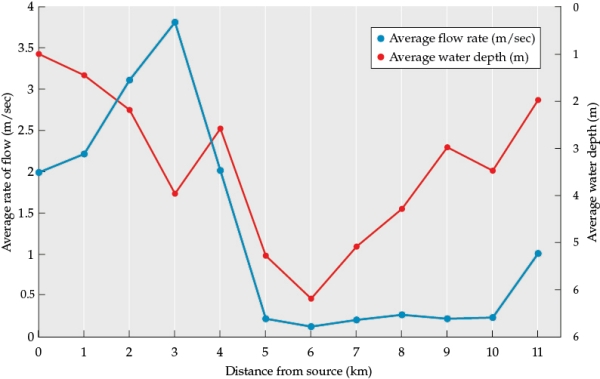 You are studying a river in its natural state, unaffected by human activities. Your data are graphed in Figure 1. You began collecting data at the source of the river ("0 km" on the figure) and continued to sample the river every 1 km.
-The river you were studying (data in Figure 1) is suddenly diverted at its source and the entire river channel path is changed. The former path of the river is now terrestrial. Based on the data on river flow and water depth collected before the river was diverted (Figure 1), which areas would be most likely to have soils with the highest cation exchange capacity after river diversion, and why? Give your answer as the distance in km from the former source of the river.
Correct Answer:

Verified
View Answer
Unlock this answer now
Get Access to more Verified Answers free of charge
Q49: Which of the following is not a
Q50: Why is upwelling important for the commercial
Q51: Refer to the figure.
Figure 1

Q52: Refer to the figure.
Figure 1
Q53: Refer to the figure.
Figure 1
Q55: Refer to the figure.
Figure 1
Q56: Refer to the table and the figure.
Table
Q57: Refer to the table and the figure.
Table
Q58: Refer to the table and the figure.
Table
Q59: Refer to the table and the figure.
Table
Unlock this Answer For Free Now!
View this answer and more for free by performing one of the following actions

Scan the QR code to install the App and get 2 free unlocks

Unlock quizzes for free by uploading documents