Now imagine that the votes for each party shown in Table 2 are the same, but that they are for a district where 10 candidates are elected using a highest average system to allocate seats. This means that the votes parties receive are divided by a series of numbers to give quotients. This country uses the d'Hondt method (the divisors are 1, 2, 3, 4, . . . ) . Seats are allocated to the party with the largest quotient, then the second largest, then the third largest . . . until all of the seats have been allocated. In Table 3, the quotients have already been calculated for you and are shown in italics. Use Table 3 to answer Questions .
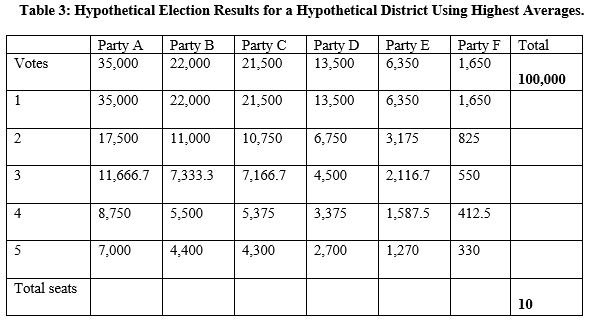
-If the election results shown in Table 3 above were for a district with a magnitude of 1 and plurality rule was used (in other words, you have an single-member district plurality system) , what would the outcome be?
A) Candidates from parties A and B would each win 5 seats.
B) Candidates from party A would win 10 seats.
C) A candidate from party A would win 1 seat and the other parties would get 0 seats.
D) You can't answer this question unless you know what the second, third, fourth, and so on, preference ranking is on each ballot that was cast.
Correct Answer:

Verified
Q12: The hypothetical election results shown in
Q13: The hypothetical election results shown in
Q14: The hypothetical election results shown in
Q15: Now imagine that the votes for each
Q16: Now imagine that the votes for each
Q18: Now imagine that the votes for each
Q19: All proportional electoral systems have natural thresholds.
Q20: Which type of party list gives the
Q21: Countries with electoral tiers above the district
Q22: Which of the following is NOT a
Unlock this Answer For Free Now!
View this answer and more for free by performing one of the following actions

Scan the QR code to install the App and get 2 free unlocks

Unlock quizzes for free by uploading documents