Now imagine that the votes for each party shown in Table 2 are the same, but that they are for a district where 10 candidates are elected using a highest average system to allocate seats. This means that the votes parties receive are divided by a series of numbers to give quotients. This country uses the d'Hondt method (the divisors are 1, 2, 3, 4, . . . ) . Seats are allocated to the party with the largest quotient, then the second largest, then the third largest . . . until all of the seats have been allocated. In Table 3, the quotients have already been calculated for you and are shown in italics. Use Table 3 to answer Questions .
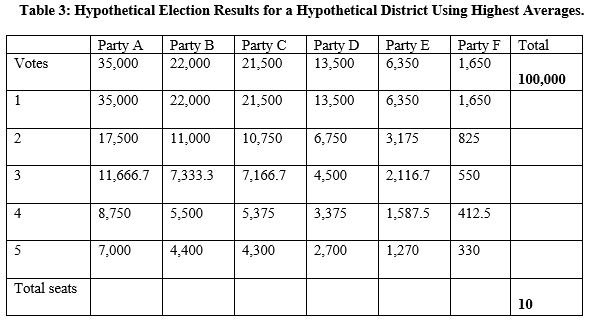
-If the election results shown in Table 3, above, were for a district with a magnitude of 1 and the alternative vote rule was used, what would the outcome be?
A) candidates from parties A and B would each win 5 seats.
B) candidates from party A would win 10 seats.
C) a candidate from party A would win 1 seat and the other parties would get 0 seats.
D) you can't answer this question unless you know what the second, third, fourth, and so on, preference ranking is on each ballot that was cast.
Correct Answer:

Verified
Q13: The hypothetical election results shown in
Q14: The hypothetical election results shown in
Q15: Now imagine that the votes for each
Q16: Now imagine that the votes for each
Q17: Now imagine that the votes for each
Q19: All proportional electoral systems have natural thresholds.
Q20: Which type of party list gives the
Q21: Countries with electoral tiers above the district
Q22: Which of the following is NOT a
Q23: What is a mixed electoral system?
A) It
Unlock this Answer For Free Now!
View this answer and more for free by performing one of the following actions

Scan the QR code to install the App and get 2 free unlocks

Unlock quizzes for free by uploading documents