Choosing Electoral Rules: A Game-Theoretic Approach
When would incumbent politicians be likely to abandon disproportional single-member district electoral laws in favor of a "fairer" proportional representation system (as occurred in New Zealand about a decade ago) ?
The following game can be used to explain the prospects for institutional reform in democracies. To keep things simple, we can think about the prospect for institutional reform (such as a change from single-member district plurality rule to proportional representation) as a game between a large party and a small party. They each must decide whether to vote for or against the proposed electoral reform. If the large party votes against reform, reform efforts fail and the next election is conducted under the existing rules.
Assume that voters prefer a more proportional electoral system. Thus, parties enjoy an electoral benefit if they vote for reform, but only if the other party votes against reform. Conversely, if a party votes against the reform, it pays a cost, but only if the other party votes for. Payoffs representing this electoral reform game are displayed in the following strategic-form game, where the large party's net electoral benefits from blocking reform are larger than the benefits the parties enjoy from being seen as lone reformers.
Figure 1. The Electoral Reform Game-Example 1
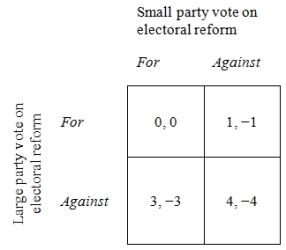
-What strategy combination(s) form(s) a Nash equilibrium in the above game? Hint: use the form (Large strategy; Small strategy) .
A) For; For
B) For; Against and Against; For
C) Against; For
D) Against; Against
E) For; Against
Correct Answer:

Verified
Q41: Answer the following questions. Q42: Answer the following questions. Q43: Answer the following questions. Q44: Answer the following questions. Q45: All electoral systems create at least some Q47: Choosing Electoral Rules: A Game-Theoretic Approach Q48: Now, suppose the large party controls which Q49: Now, suppose the large party controls which Q50: Now, let's ask what happens when the Q51: Now, let's ask what happens when the Unlock this Answer For Free Now! View this answer and more for free by performing one of the following actions Scan the QR code to install the App and get 2 free unlocks Unlock quizzes for free by uploading documents

When would

