Now, suppose the large party controls which bills are voted on (perhaps because it controls the relevant committee in the legislature) . The game below is similar to the one above, but now the large party can choose to propose a reform (in which case the parties play a version of the game above) , or they can block a reform bill before it gets to the floor (in which case they compete against the small party under existing laws) . Answer the following questions.
Figure 2: The Electoral Reform Game-When the Large Party Controls the Legislative Agenda
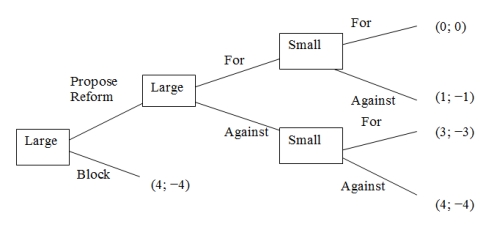
-What strategy combinations form a subgame perfect Nash equilibrium to the above game? Hint: use the form (Large's move at first node, Large's move at second node; Small's move at top node, Small's move at bottom node) .
A) Block
B) Block, Against; For, Against
C) Block, Against; For, For
D) Propose reform, For; For, Against
E) Against; For
Correct Answer:

Verified
Q42: Answer the following questions. Q43: Answer the following questions. Q44: Answer the following questions. Q45: All electoral systems create at least some Q46: Choosing Electoral Rules: A Game-Theoretic Approach Q47: Choosing Electoral Rules: A Game-Theoretic Approach Q49: Now, suppose the large party controls which Q50: Now, let's ask what happens when the Q51: Now, let's ask what happens when the Q52: Now, let's ask what happens when the Unlock this Answer For Free Now! View this answer and more for free by performing one of the following actions Scan the QR code to install the App and get 2 free unlocks Unlock quizzes for free by uploading documents

When would
When would

