Solved

Hidden Assumptions That Make Equilibrium Calculations Easier What Do We

Question 44

Multiple Choice

Hidden Assumptions that make Equilibrium Calculations Easier What Do We Do When the Approximation Fails?
based on the following reaction:

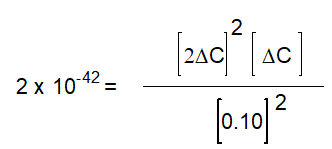
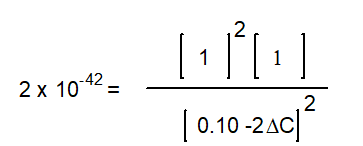
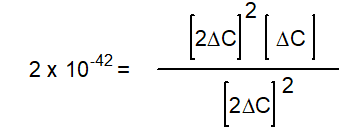
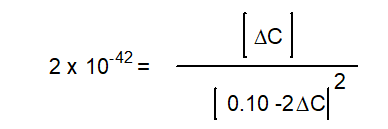
2H2O(g) Hidden Assumptions that make Equilibrium Calculations Easier What Do We Do When the Approximation Fails?  based on the following reaction:  2H<sub>2</sub>O(g)    2H<sub>2</sub>(g)  + O<sub>2</sub>(g)  K<sub>c</sub> = 2 x 10<sup>-42</sup> (at 25<sup>o</sup>C)  -The equation below solves for the change in concentration for the given reaction assuming the initial concentration of H<sub>2</sub>O(g)  is 0.10 M. Which equation will result if it is assumed that the change will be much smaller than the initial concentration of H<sub>2</sub>O(g) ?    A)     B)     C)     D)     E)  None of the above 2H2(g) + O2(g)
Kc = 2 x 10-42 (at 25oC)
-The equation below solves for the change in concentration for the given reaction assuming the initial concentration of H2O(g) is 0.10 M. Which equation will result if it is assumed that the change will be much smaller than the initial concentration of H2O(g) ?
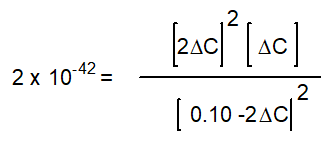
Hidden Assumptions that make Equilibrium Calculations Easier What Do We Do When the Approximation Fails?  based on the following reaction:  2H<sub>2</sub>O(g)    2H<sub>2</sub>(g)  + O<sub>2</sub>(g)  K<sub>c</sub> = 2 x 10<sup>-42</sup> (at 25<sup>o</sup>C)  -The equation below solves for the change in concentration for the given reaction assuming the initial concentration of H<sub>2</sub>O(g)  is 0.10 M. Which equation will result if it is assumed that the change will be much smaller than the initial concentration of H<sub>2</sub>O(g) ?    A)     B)     C)     D)     E)  None of the above


A) Hidden Assumptions that make Equilibrium Calculations Easier What Do We Do When the Approximation Fails?  based on the following reaction:  2H<sub>2</sub>O(g)    2H<sub>2</sub>(g)  + O<sub>2</sub>(g)  K<sub>c</sub> = 2 x 10<sup>-42</sup> (at 25<sup>o</sup>C)  -The equation below solves for the change in concentration for the given reaction assuming the initial concentration of H<sub>2</sub>O(g)  is 0.10 M. Which equation will result if it is assumed that the change will be much smaller than the initial concentration of H<sub>2</sub>O(g) ?    A)     B)     C)     D)     E)  None of the above
B) Hidden Assumptions that make Equilibrium Calculations Easier What Do We Do When the Approximation Fails?  based on the following reaction:  2H<sub>2</sub>O(g)    2H<sub>2</sub>(g)  + O<sub>2</sub>(g)  K<sub>c</sub> = 2 x 10<sup>-42</sup> (at 25<sup>o</sup>C)  -The equation below solves for the change in concentration for the given reaction assuming the initial concentration of H<sub>2</sub>O(g)  is 0.10 M. Which equation will result if it is assumed that the change will be much smaller than the initial concentration of H<sub>2</sub>O(g) ?    A)     B)     C)     D)     E)  None of the above
C) Hidden Assumptions that make Equilibrium Calculations Easier What Do We Do When the Approximation Fails?  based on the following reaction:  2H<sub>2</sub>O(g)    2H<sub>2</sub>(g)  + O<sub>2</sub>(g)  K<sub>c</sub> = 2 x 10<sup>-42</sup> (at 25<sup>o</sup>C)  -The equation below solves for the change in concentration for the given reaction assuming the initial concentration of H<sub>2</sub>O(g)  is 0.10 M. Which equation will result if it is assumed that the change will be much smaller than the initial concentration of H<sub>2</sub>O(g) ?    A)     B)     C)     D)     E)  None of the above
D) Hidden Assumptions that make Equilibrium Calculations Easier What Do We Do When the Approximation Fails?  based on the following reaction:  2H<sub>2</sub>O(g)    2H<sub>2</sub>(g)  + O<sub>2</sub>(g)  K<sub>c</sub> = 2 x 10<sup>-42</sup> (at 25<sup>o</sup>C)  -The equation below solves for the change in concentration for the given reaction assuming the initial concentration of H<sub>2</sub>O(g)  is 0.10 M. Which equation will result if it is assumed that the change will be much smaller than the initial concentration of H<sub>2</sub>O(g) ?    A)     B)     C)     D)     E)  None of the above
E) None of the above

Correct Answer:

verifed

Verified

Unlock this answer now
Get Access to more Verified Answers free of charge

Related Questions

Unlock this Answer For Free Now!

View this answer and more for free by performing one of the following actions

qr-code

Scan the QR code to install the App and get 2 free unlocks

upload documents

Unlock quizzes for free by uploading documents