Solved

Individuals Infected with Herpes Simplex Virus (HSV) Mount Protective Antibody \to

Question 26

Essay

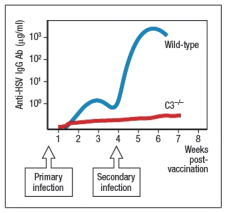
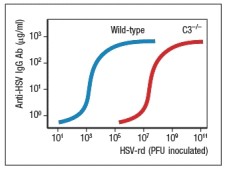
Individuals infected with herpes simplex virus (HSV) mount protective antibody responses directed against the surface glycoproteins of the virus. These antibodies are critical to viral clearance, contributing to viral neutralization as well as to complement-mediated and cytotoxic cell-mediated killing of infected target cells. Surprisingly, humans as well as mice deficient in the complement protein, C3, have greatly reduced antibody responses to T cell-dependent antigens, and are impaired in their ability to control HSV infections. When C3-deficient mice are infected with HSV, once at day 0 and then a second time 4 weeks later, their antibody response is altered compared to wild-type mice, as shown in Figure.  Individuals infected with herpes simplex virus (HSV) mount protective antibody responses directed against the surface glycoproteins of the virus. These antibodies are critical to viral clearance, contributing to viral neutralization as well as to complement-mediated and cytotoxic cell-mediated killing of infected target cells. Surprisingly, humans as well as mice deficient in the complement protein, C3, have greatly reduced antibody responses to T cell-dependent antigens, and are impaired in their ability to control HSV infections. When C3-deficient mice are infected with HSV, once at day 0 and then a second time 4 weeks later, their antibody response is altered compared to wild-type mice, as shown in Figure.     a) What is a likely explanation for the altered antibody response in the absence of complement C3? To test your hypothesis, the following experiment is performed. Wild-type and C3<sup>-/-</sup> mice are each inoculated with a replication-defective form of HSV (HSV-rd). This virus infects cells, stimulates innate immune responses, but is not able to replicate and spread in the body. For this experiment, mice are infected with varying doses of the HSV-rd virus, and peak IgG responses to the viral surface glycoproteins are measured. The results are shown in Figure.    b) What is the most likely explanation for these data? Do these results impact your answer to part (a)? Explain your reasoning. To further elucidate the function of complement C3 in the humoral immune response, a knockout mouse line lacking the receptor for C3 fragments is generated. This receptor is encoded by the Cr2 gene, so knockout mice lacking this gene are known as Cr2-/-.  Previous studies have indicated that the complement receptor encoded by the Cr2 gene is expressed on B cells and on the follicular dendritic cells that reside in B cell zones of secondary lymphoid organs. To distinguish the functions of the complement receptor on these two cell types, a series of bone marrow chimeras are generated. Wild-type bone marrow is used to reconstitute lethally irradiated Cr2<sup>-/-</sup> mice (wt \to Cr2-/-), or vice versa (Cr2-/- \to wt). As controls, Cr2<sup>-/-</sup> bone marrow is used to reconstitute Cr2-/- recipients (Cr2-/- \to Cr2-/-), and wild-type bone marrow used to reconstitute wild-type recipients (wt \to wt). These mice are then inoculated with the HSV-rd virus at 10<sup>6</sup> PFU, once at day 0 and then a second time at day 28, and the anti-HSV IgG responses are measured every 7 days, as shown in Figure.    c) From the data shown above, on which cell type is the expression of the complement receptor most important for humoral immunity? d) For each of the cell types expressing the complement receptor encoded by Cr2, what is the explanation for their importance in humoral immunity to HSV inoculation?
a) What is a likely explanation for the altered antibody response in the absence of complement C3?
To test your hypothesis, the following experiment is performed. Wild-type and C3-/- mice are each inoculated with a replication-defective form of HSV (HSV-rd). This virus infects cells, stimulates innate immune responses, but is not able to replicate and spread in the body. For this experiment, mice are infected with varying doses of the HSV-rd virus, and peak IgG responses to the viral surface glycoproteins are measured. The results are shown in Figure.  Individuals infected with herpes simplex virus (HSV) mount protective antibody responses directed against the surface glycoproteins of the virus. These antibodies are critical to viral clearance, contributing to viral neutralization as well as to complement-mediated and cytotoxic cell-mediated killing of infected target cells. Surprisingly, humans as well as mice deficient in the complement protein, C3, have greatly reduced antibody responses to T cell-dependent antigens, and are impaired in their ability to control HSV infections. When C3-deficient mice are infected with HSV, once at day 0 and then a second time 4 weeks later, their antibody response is altered compared to wild-type mice, as shown in Figure.     a) What is a likely explanation for the altered antibody response in the absence of complement C3? To test your hypothesis, the following experiment is performed. Wild-type and C3<sup>-/-</sup> mice are each inoculated with a replication-defective form of HSV (HSV-rd). This virus infects cells, stimulates innate immune responses, but is not able to replicate and spread in the body. For this experiment, mice are infected with varying doses of the HSV-rd virus, and peak IgG responses to the viral surface glycoproteins are measured. The results are shown in Figure.    b) What is the most likely explanation for these data? Do these results impact your answer to part (a)? Explain your reasoning. To further elucidate the function of complement C3 in the humoral immune response, a knockout mouse line lacking the receptor for C3 fragments is generated. This receptor is encoded by the Cr2 gene, so knockout mice lacking this gene are known as Cr2-/-.  Previous studies have indicated that the complement receptor encoded by the Cr2 gene is expressed on B cells and on the follicular dendritic cells that reside in B cell zones of secondary lymphoid organs. To distinguish the functions of the complement receptor on these two cell types, a series of bone marrow chimeras are generated. Wild-type bone marrow is used to reconstitute lethally irradiated Cr2<sup>-/-</sup> mice (wt \to Cr2-/-), or vice versa (Cr2-/- \to wt). As controls, Cr2<sup>-/-</sup> bone marrow is used to reconstitute Cr2-/- recipients (Cr2-/- \to Cr2-/-), and wild-type bone marrow used to reconstitute wild-type recipients (wt \to wt). These mice are then inoculated with the HSV-rd virus at 10<sup>6</sup> PFU, once at day 0 and then a second time at day 28, and the anti-HSV IgG responses are measured every 7 days, as shown in Figure.    c) From the data shown above, on which cell type is the expression of the complement receptor most important for humoral immunity? d) For each of the cell types expressing the complement receptor encoded by Cr2, what is the explanation for their importance in humoral immunity to HSV inoculation?
b) What is the most likely explanation for these data? Do these results impact your answer to part (a)? Explain your reasoning.
To further elucidate the function of complement C3 in the humoral immune response, a knockout mouse line lacking the receptor for C3 fragments is generated. This receptor is encoded by the Cr2 gene, so knockout mice lacking this gene are known as Cr2-/-.
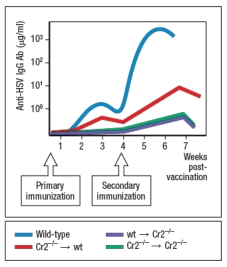
Previous studies have indicated that the complement receptor encoded by the Cr2 gene is expressed on B cells and on the follicular dendritic cells that reside in B cell zones of secondary lymphoid organs. To distinguish the functions of the complement receptor on these two cell types, a series of bone marrow chimeras are generated. Wild-type bone marrow is used to reconstitute lethally irradiated Cr2-/- mice (wt \to Cr2-/-), or vice versa (Cr2-/- \to wt). As controls, Cr2-/- bone marrow is used to reconstitute Cr2-/- recipients (Cr2-/- \to Cr2-/-), and wild-type bone marrow used to reconstitute wild-type recipients (wt \to wt). These mice are then inoculated with the HSV-rd virus at 106 PFU, once at day 0 and then a second time at day 28, and the anti-HSV IgG responses are measured every 7 days, as shown in Figure.  Individuals infected with herpes simplex virus (HSV) mount protective antibody responses directed against the surface glycoproteins of the virus. These antibodies are critical to viral clearance, contributing to viral neutralization as well as to complement-mediated and cytotoxic cell-mediated killing of infected target cells. Surprisingly, humans as well as mice deficient in the complement protein, C3, have greatly reduced antibody responses to T cell-dependent antigens, and are impaired in their ability to control HSV infections. When C3-deficient mice are infected with HSV, once at day 0 and then a second time 4 weeks later, their antibody response is altered compared to wild-type mice, as shown in Figure.     a) What is a likely explanation for the altered antibody response in the absence of complement C3? To test your hypothesis, the following experiment is performed. Wild-type and C3<sup>-/-</sup> mice are each inoculated with a replication-defective form of HSV (HSV-rd). This virus infects cells, stimulates innate immune responses, but is not able to replicate and spread in the body. For this experiment, mice are infected with varying doses of the HSV-rd virus, and peak IgG responses to the viral surface glycoproteins are measured. The results are shown in Figure.    b) What is the most likely explanation for these data? Do these results impact your answer to part (a)? Explain your reasoning. To further elucidate the function of complement C3 in the humoral immune response, a knockout mouse line lacking the receptor for C3 fragments is generated. This receptor is encoded by the Cr2 gene, so knockout mice lacking this gene are known as Cr2-/-.  Previous studies have indicated that the complement receptor encoded by the Cr2 gene is expressed on B cells and on the follicular dendritic cells that reside in B cell zones of secondary lymphoid organs. To distinguish the functions of the complement receptor on these two cell types, a series of bone marrow chimeras are generated. Wild-type bone marrow is used to reconstitute lethally irradiated Cr2<sup>-/-</sup> mice (wt \to Cr2-/-), or vice versa (Cr2-/- \to wt). As controls, Cr2<sup>-/-</sup> bone marrow is used to reconstitute Cr2-/- recipients (Cr2-/- \to Cr2-/-), and wild-type bone marrow used to reconstitute wild-type recipients (wt \to wt). These mice are then inoculated with the HSV-rd virus at 10<sup>6</sup> PFU, once at day 0 and then a second time at day 28, and the anti-HSV IgG responses are measured every 7 days, as shown in Figure.    c) From the data shown above, on which cell type is the expression of the complement receptor most important for humoral immunity? d) For each of the cell types expressing the complement receptor encoded by Cr2, what is the explanation for their importance in humoral immunity to HSV inoculation?
c) From the data shown above, on which cell type is the expression of the complement receptor most important for humoral immunity?
d) For each of the cell types expressing the complement receptor encoded by Cr2, what is the explanation for their importance in humoral immunity to HSV inoculation?

Correct Answer:

verifed

Verified

a) There are two possible :
1. Defect in...

View Answer

Unlock this answer now
Get Access to more Verified Answers free of charge

Related Questions

Unlock this Answer For Free Now!

View this answer and more for free by performing one of the following actions

qr-code

Scan the QR code to install the App and get 2 free unlocks

upload documents

Unlock quizzes for free by uploading documents