Solved

Immunodeficiency Diseases Arise When Individuals Lack One or More Components β\beta

Question 27

Essay

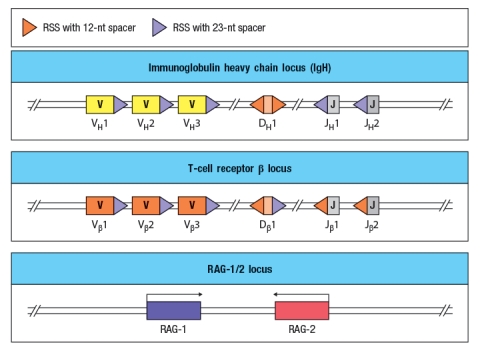
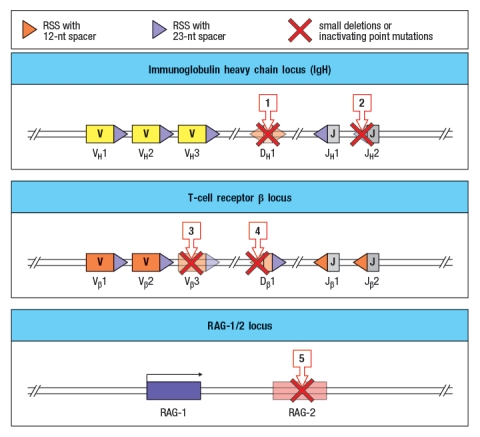
Immunodeficiency diseases arise when individuals lack one or more components of their immune system, and are identified by an individual's history of persistent or recurrent infections. Some genetic defects (mutations or small deletions) can cause profound defects in an immune cell population; alternatively, in some cases, such small defects occur that there is no visible effect on immune responses. The diagram in Figure shows simplified versions of the immunoglobulin heavy chain locus, the T-cell receptor β\beta chain locus, and the locus encoding the RAG-1 and RAG-2 recombinases. For the sake of this question, imagine that these diagrams represent all of the gene segments present in the immunoglobulin heavy chain and T-cell receptor β\beta chain locus.  Immunodeficiency diseases arise when individuals lack one or more components of their immune system, and are identified by an individual's history of persistent or recurrent infections. Some genetic defects (mutations or small deletions) can cause profound defects in an immune cell population; alternatively, in some cases, such small defects occur that there is no visible effect on immune responses. The diagram in Figure shows simplified versions of the immunoglobulin heavy chain locus, the T-cell receptor  \beta chain locus, and the locus encoding the RAG-1 and RAG-2 recombinases. For the sake of this question, imagine that these diagrams represent all of the gene segments present in the immunoglobulin heavy chain and T-cell receptor  \beta  chain locus.    You now analyze five individuals, each of which has a single inactivating mutation in a region of one of these three loci. These mutations are each indicated by a red 'X' in Figure , and are numbered 1-5. For each of these inactivating mutations, indicate the alterations and/or defects that would be seen in the repertoire of antigen receptors found in mature B and T cells in that individual. Also, for each mutation, indicate whether the individual would likely show any immunodeficiency, such as a history of recurrent infections.
You now analyze five individuals, each of which has a single inactivating mutation in a region of one of these three loci. These mutations are each indicated by a red 'X' in Figure , and are numbered 1-5. For each of these inactivating mutations, indicate the alterations and/or defects that would be seen in the repertoire of antigen receptors found in mature B and T cells in that individual. Also, for each mutation, indicate whether the individual would likely show any immunodeficiency, such as a history of recurrent infections.  Immunodeficiency diseases arise when individuals lack one or more components of their immune system, and are identified by an individual's history of persistent or recurrent infections. Some genetic defects (mutations or small deletions) can cause profound defects in an immune cell population; alternatively, in some cases, such small defects occur that there is no visible effect on immune responses. The diagram in Figure shows simplified versions of the immunoglobulin heavy chain locus, the T-cell receptor  \beta chain locus, and the locus encoding the RAG-1 and RAG-2 recombinases. For the sake of this question, imagine that these diagrams represent all of the gene segments present in the immunoglobulin heavy chain and T-cell receptor  \beta  chain locus.    You now analyze five individuals, each of which has a single inactivating mutation in a region of one of these three loci. These mutations are each indicated by a red 'X' in Figure , and are numbered 1-5. For each of these inactivating mutations, indicate the alterations and/or defects that would be seen in the repertoire of antigen receptors found in mature B and T cells in that individual. Also, for each mutation, indicate whether the individual would likely show any immunodeficiency, such as a history of recurrent infections.
Correct Answer:

verifed

Verified

1. This mutation/deletion takes out the ...

View Answer

Unlock this answer now
Get Access to more Verified Answers free of charge

Related Questions

Unlock this Answer For Free Now!

View this answer and more for free by performing one of the following actions

qr-code

Scan the QR code to install the App and get 2 free unlocks

upload documents

Unlock quizzes for free by uploading documents