An 84-year-old man comes to the emergency department due to a week-long history of dizziness, lightheadedness, and shortness of breath. His symptoms occur at any time but are worse with exertion. He has had no chest pain, palpitations, or syncope. Medical history includes hypertension, hypercholesterolemia, and benign prostatic hyperplasia. His medications are aspirin, lisinopril, atorvastatin, and tamsulosin.
Temperature is 36.7 C (98 F) , blood pressure is 120/60 mm Hg, pulse is 36/min, and respirations are 16/min. On examination, the patient appears in no acute distress and has no symptoms. Other than a slow pulse rate, physical examination shows no abnormalities.
Initial laboratory studies, including complete metabolic panel, thyroid function tests, and cardiac markers, are within normal limits.
ECG is shown in the exhibit. 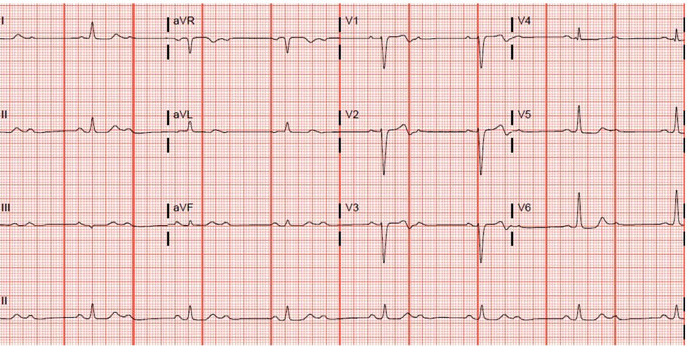
A transthoracic echocardiogram shows normal right and left ventricular size and function with an ejection fraction of 60%, along with mild mitral and tricuspid regurgitation.
Which of the following is the best next step in management of this patient?
A) 24-hour ECG monitoring
B) Intravenous atropine
C) Intravenous dobutamine
D) Permanent pacemaker
E) Transcutaneous pacing
Correct Answer:

Verified
Q15: A 55-year-old construction worker is brought to
Q16: A 72-year-old woman with a history of
Q17: A 26-year-old primigravid woman at 36 weeks
Q18: A 75-year-old man comes to the emergency
Q19: A 52-year-old woman is undergoing screening colonoscopy
Q21: A 52-year-old man comes to the physician
Q22: A 38-year-old man admitted with severe, acute
Q23: A 56-year-old man comes to the emergency
Q24: A 48-year-old woman is admitted to the
Q25: A 22-year-old woman is brought to the
Unlock this Answer For Free Now!
View this answer and more for free by performing one of the following actions

Scan the QR code to install the App and get 2 free unlocks

Unlock quizzes for free by uploading documents