An 89-year-old man is hospitalized because of upper GI bleeding. He presented two days ago with hematemesis, black stools, and lethargy. His trachea was intubated for airway protection in the emergency department. An endoscopy was performed and showed a deep ulcer with a bleeding vessel in the gastric antrum. Hemostasis was achieved with epinephrine injection, cauterization, and endoclips. He received 8 units of packed red blood cells and has not required additional transfusions for the past 24 hours. His other medical problems include hypertension, chronic kidney disease, hypothyroidism, and colon cancer requiring colectomy and adjuvant chemotherapy 9 years ago.
The patient undergoes a spontaneous breathing trial in the intensive care unit. After two hours of 5 cm H2O continuous positive airway pressure (CPAP) , his temperature is 36.1 C (97 F) , blood pressure is 110/60 mm Hg, pulse is 94/min, and respirations are 28/min. The patient's pulse oximetry shows 97% on 40% FiO2. His tidal volumes are 200 mL on average. He follows commands adequately. Examination reveals good air entry on both sides and bibasal crackles. No cardiac murmurs are appreciated. There is 2+ bilateral pretibial edema. Muscle strength is 5/5 in both upper and lower extremities.
Laboratory results are as follows: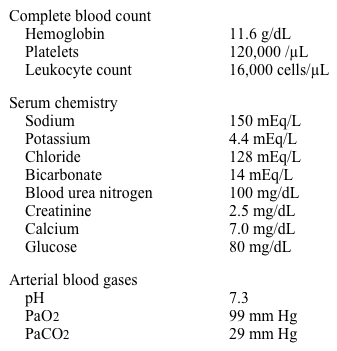
His chest-x ray shows bilateral airspace opacities.
Which of the following is the most appropriate next step in management?
A) Continue CPAP and repeat arterial blood gases in 60 minutes
B) Extubate the patient to nasal cannula
C) Extubate the patient to noninvasive ventilation
D) Place the patient on assist control
E) Refer the patient for tracheotomy
Correct Answer:

Verified
Q79: A 53-year-old woman is brought to the
Q80: A 35-year-old woman comes to the emergency
Q81: A 63-year-old hospitalized woman develops severe shortness
Q82: A 52-year-old man with alcoholic cirrhosis is
Q83: A 76-year old man is admitted because
Q85: A 73-year-old smoker is brought to the
Q86: A 63-year-old man is hospitalized with dyspnea
Q87: A 55-year-old man is evaluated for acute
Q88: A 74-year-old woman is brought to the
Q89: A 74-year-old man is brought back to
Unlock this Answer For Free Now!
View this answer and more for free by performing one of the following actions

Scan the QR code to install the App and get 2 free unlocks

Unlock quizzes for free by uploading documents