A 63-year-old man is hospitalized with dyspnea due to right lower lobe pneumonia. On the third day of hospitalization, he develops progressive respiratory failure and bilateral lung infiltrates. His trachea was intubated and mechanical ventilation is initiated.
His blood pressure is 146/80 mm Hg, and pulse is 97/min. The patient's pulse oximetry shows 89% on assist-control mode with tidal volumes of 450 mL, respiratory rate of 30/min, fraction of inspired oxygen of 100%, and positive end-expiratory pressure of 12 cm H2O. Examination shows diffuse crackles all over the lung fields, normal first and second heart sounds, and capillary refill of < 2 seconds. There is trace pre-sacral edema.
Laboratory results are as follows: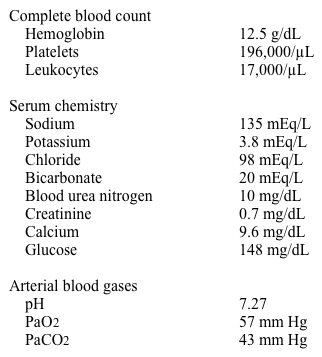
His chest-x ray reveals dense bilateral alveolar opacities. Bedside echocardiogram shows left ventricular ejection fraction of 65%. A central line is placed and the central venous pressure is 10 mm Hg.
Conservative fluid management using diuretic therapy in this patient is most likely to positively affect which of the following?
A) In-hospital mortality
B) Oxygen saturation in mixed venous blood
C) Residual lung function
D) Risk of acute kidney injury
E) Ventilator-free days
Correct Answer:

Verified
Q81: A 63-year-old hospitalized woman develops severe shortness
Q82: A 52-year-old man with alcoholic cirrhosis is
Q83: A 76-year old man is admitted because
Q84: An 89-year-old man is hospitalized because of
Q85: A 73-year-old smoker is brought to the
Q87: A 55-year-old man is evaluated for acute
Q88: A 74-year-old woman is brought to the
Q89: A 74-year-old man is brought back to
Q90: A 57-year-old man undergoes bronchoscopy for a
Q91: A 68-year-old woman is evaluated in the
Unlock this Answer For Free Now!
View this answer and more for free by performing one of the following actions

Scan the QR code to install the App and get 2 free unlocks

Unlock quizzes for free by uploading documents