A 25-year-old woman being treated for infective endocarditis is evaluated for new-onset renal dysfunction. The patient has a 2-year history of injection drug use and presented 3 weeks ago with subjective fevers, pleuritic chest pain, and shortness of breath. Chest CT imaging with contrast revealed peripheral nodular opacities consistent with septic emboli, and blood cultures were positive for Enterococcus faecalis. Echocardiography showed tricuspid valve vegetations without valvular insufficiency or abnormal cardiac function. The patient has been receiving intravenous ampicillin and ceftriaxone, and repeat blood cultures have been negative. Yesterday, she was noted to have elevated serum creatinine on routine weekly laboratory studies. The patient has no nausea, vomiting, flank pain, rash, dysuria, or chills. She continues to void regularly with no changes in appearance or volume of her urine.
Temperature is 38.3 C (100.9 F) , blood pressure is 122/64 mm Hg, pulse is 90/min, and respirations are 14/min. Physical examination shows no jugular venous distension, and auscultation of the heart and lungs is normal. There is no abdominal or costovertebral angle tenderness. No rash or edema is present.
Repeat laboratory results are as follows: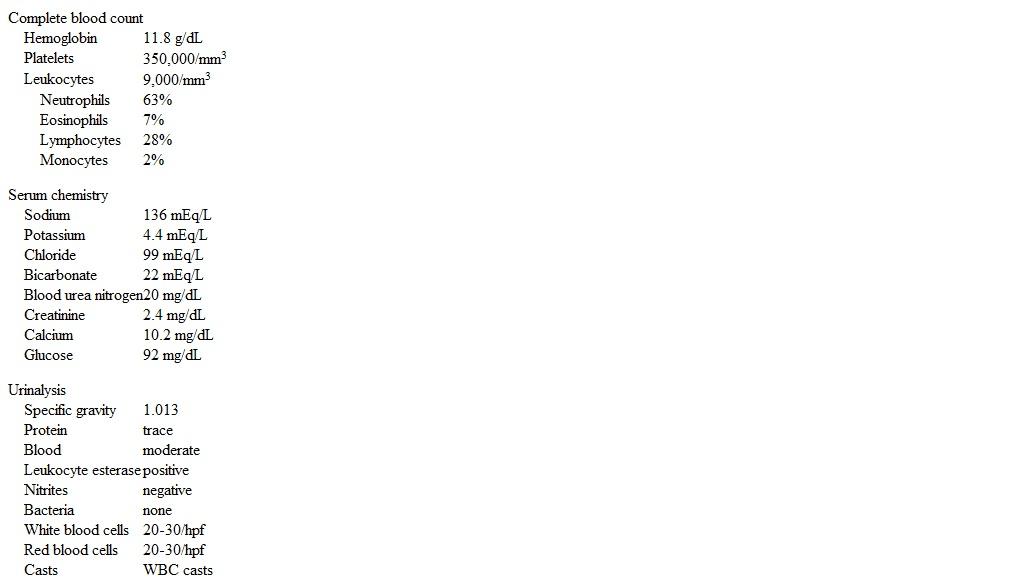 Which of the following is the most likely diagnosis in this patient?
A) Cholesterol embolization
B) Contrast-induced nephropathy
C) Drug-induced acute interstitial nephritis
D) Drug-induced acute tubular necrosis
E) Immune complex-mediated glomerulonephritis
Correct Answer:

Verified
Q99: A 65-year-old woman with a history of
Q100: A 60-year-old woman is brought to the
Q101: A 64-year-old woman was found poorly responsive
Q102: A 48-year-old man comes to the emergency
Q103: A 48-year-old man is admitted to the
Q105: A 47-year-old man is hospitalized due to
Q106: A 76-year-old man with chronic obstructive pulmonary
Q107: A 65-year-old man is admitted to the
Q108: A 47-year-old man with known HIV infection
Q109: A 60-year-old woman is brought to the
Unlock this Answer For Free Now!
View this answer and more for free by performing one of the following actions

Scan the QR code to install the App and get 2 free unlocks

Unlock quizzes for free by uploading documents