A 68-year-old man comes to the physician because of lower extremity edema. His edema has been present for the last six months, but it has worsened lately. He denies chest pain or pressure, although he reports some exertional shortness of breath and a dry cough that occurs mostly at night. He denies any recent change in diet or medications. His other medical problems include chronic obstructive pulmonary disease and hyperlipidemia. His current medications include albuterol/ipratropium inhaler, simvastatin, and aspirin. He has smoked 1 pack of cigarettes per day for the last 48 years, but he denies alcohol or illicit drug use.
His blood pressure is 140/75 mm Hg in both arms, pulse is 60/min, and respirations are 14/min. He is in no acute distress. His jugular veins are distended with the peak of the 'a' wave poorly visualized at 90 degrees. There is a sustained parasternal lift best felt at the left lower parasternal border. There is a normal S1 with a loud S2. There is a holosystolic murmur best heard at the left sternal border that increases with inspiration. The lungs are clear bilaterally. The liver is slightly enlarged. There is 2+ pitting edema to the thighs bilaterally.
A 12 lead ECG is shown in this exhibit. 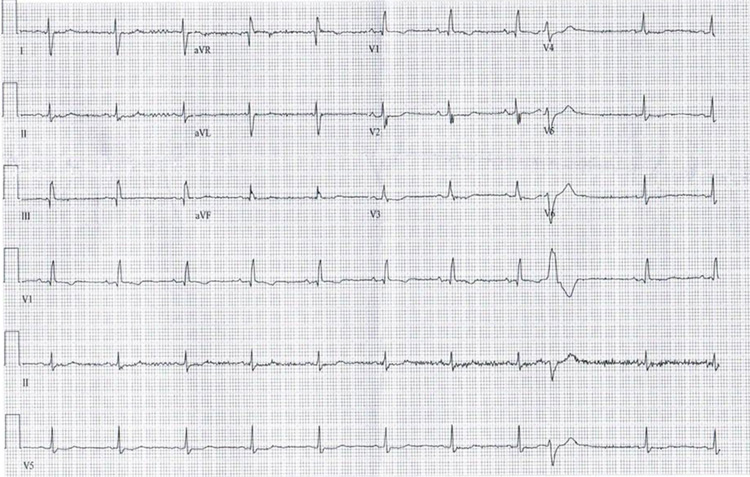
Which of the following will most likely be seen on echocardiography?
A) Aortic stenosis
B) Asymmetric septal hypertrophy
C) Left ventricular aneurysm
D) Pericardial effusion
E) Right ventricular dilatation
Correct Answer:

Verified
Q38: A 77-year-old woman comes to the physician
Q39: A 63-year-old woman is admitted to the
Q40: A 32-year-old paramedic comes to the office
Q41: A 22-year-old man comes to the office
Q42: A 76-year-old woman comes to the office
Q44: A 42-year-old man comes to the office
Q45: A 29-year-old woman comes to the physician
Q46: A 72-year-old man comes to the physician
Q47: A 76-year-old man comes to the office
Q48: A 54-year-old man comes to the physician
Unlock this Answer For Free Now!
View this answer and more for free by performing one of the following actions

Scan the QR code to install the App and get 2 free unlocks

Unlock quizzes for free by uploading documents