A 42-year-old man comes to the office due to fatigue and shortness of breath. His symptoms began 6 months ago with decreased exercise tolerance during his typical morning jog. Since then, his fatigue has gradually progressed and he has also had occasional palpitations, which he describes as his "heart races fast." The patient reports a weight gain of 5 kg (11 lb) over the last month and has had shortness of breath with mild exertion and leg swelling for the past 2 weeks. The patient does not remember any recent viral illness and has no prior medical conditions. He takes no medications, is a lifelong nonsmoker, and drinks alcohol occasionally. Family history is unremarkable.
Temperature is 37.2 C (99 F) , blood pressure is 122/80 mm Hg, pulse is 135/min and irregular, and respirations are 18/min. Jugular venous pressure is 12 cm H2O. Lung examination reveals decreased breath sounds at the bases with occasional bibasilar crackles. Cardiac examination reveals a 2/6 holosystolic murmur best heard at the apex. There is 2+ bilateral lower extremity pitting edema.
Blood cell counts, serum chemistry, and TSH are within normal limits. ECG is shown in the exhibit. 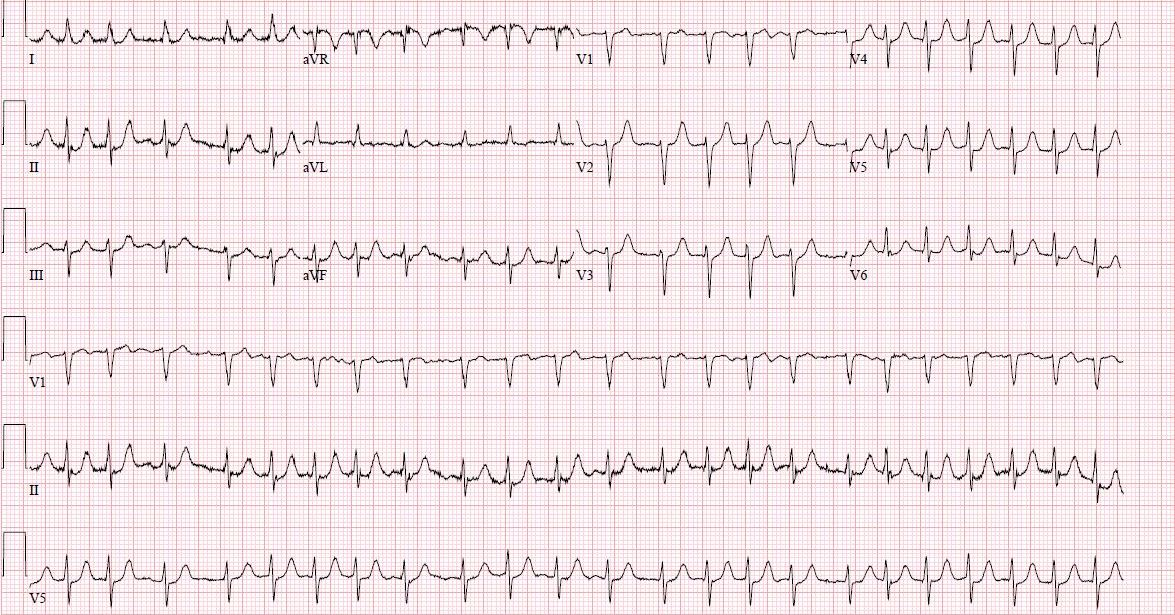 Echocardiography shows a dilated and diffusely hypokinetic left ventricle with an ejection fraction of 25%. The right ventricle is mildly hypokinetic. The left atrium is mildly dilated. There is a central jet of moderate mitral regurgitation.
Which of the following is most likely to provide the greatest long-term improvement in this patient's left ventricular function?
A) Afterload reduction
B) Coronary artery revascularization
C) Diuresis and fluid optimization
D) Heart rate control
E) Mitral valve surgery
Correct Answer:

Verified
Q39: A 63-year-old woman is admitted to the
Q40: A 32-year-old paramedic comes to the office
Q41: A 22-year-old man comes to the office
Q42: A 76-year-old woman comes to the office
Q43: A 68-year-old man comes to the physician
Q45: A 29-year-old woman comes to the physician
Q46: A 72-year-old man comes to the physician
Q47: A 76-year-old man comes to the office
Q48: A 54-year-old man comes to the physician
Q49: A 35-year-old woman comes to the physician
Unlock this Answer For Free Now!
View this answer and more for free by performing one of the following actions

Scan the QR code to install the App and get 2 free unlocks

Unlock quizzes for free by uploading documents