A 78-year-old woman is brought to the physician by her daughter due to intermittent dizziness, weakness, and confusion. The patient was seen for fever and dysuria 3 days ago and started on trimethoprim/sulfamethoxazole. Her other medical problems include type 2 diabetes mellitus, hypertension, and chronic kidney disease with a baseline serum creatinine of 1.3 mg/dL. Her chronic medications include hydrochlorothiazide, amlodipine, glyburide, atorvastatin, calcium, vitamin D, and alendronate.
Her temperature is 36.8 C (98.2 F) , blood pressure is 140/85 mm Hg supine and 144/89 mm Hg standing, pulse is 84/min, and respirations are 20/min. BMI is 19 kg/m2. There are no focal neurologic findings. Her Mini-Mental State Examination score is 24/30.
Laboratory results are as follows: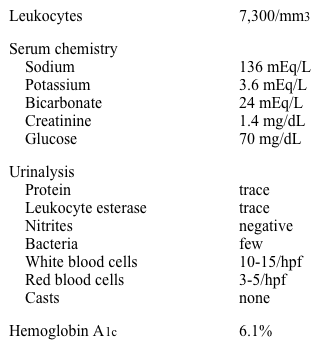
Which of the following is the best next step in management of this patient?
A) Discontinue glyburide
B) Discontinue hydrochlorothiazide
C) Order CT scan of the head
D) Order renal ultrasound
E) Send urine cultures and adjust antibiotics
Correct Answer:

Verified
Q203: A 34-year-old woman comes to the office
Q204: A 41-year-old woman comes to the office
Q205: A 54-year-old man comes to the physician
Q206: A 51-year-old woman comes to the office
Q207: A 56-year-old woman comes to the physician
Q209: A 54-year-old man comes to the physician
Q210: A 65-year-old woman comes to the physician
Q211: A 30-year-old man comes to the physician
Q212: A 30-year-old woman comes to the office
Q213: A 35-year-old man comes to the office
Unlock this Answer For Free Now!
View this answer and more for free by performing one of the following actions

Scan the QR code to install the App and get 2 free unlocks

Unlock quizzes for free by uploading documents