A 30-year-old man comes to the physician because of decreased sexual desire over the last 3 months. He says that he is otherwise healthy and has no other complaints. His other medical problems include hypercholesterolemia and migraine headaches. He was prescribed topiramate 4 months ago by his previous primary care physician for frequent headaches, but it did not seem to help much. He does not use tobacco or drink alcohol. He has a sedentary lifestyle and has gained 24 lbs (10.9 kg) in the past 3 years. His sister suffers from migraine headaches and his father had a myocardial infarction at the age of 45.
His blood pressure is 132/80 mm Hg and pulse is 72/min. The patient's body mass index (BMI) is 32 kg/m2. Examination shows no gynecomastia or hepatomegaly. He has normal secondary sexual characteristics. His testes are normal in size and consistency. The remainder of the examination is within normal limits.
Laboratory results are as follows: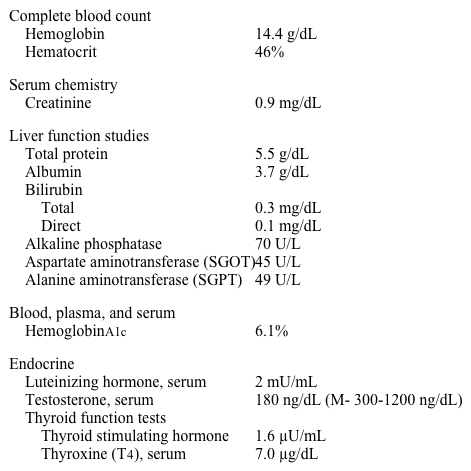
Which of the following is the most appropriate next step in management?
A) Iron studies
B) Prolactin level
C) Suggest weight loss and follow up in a few weeks
D) Testosterone therapy
E) Topiramate discontinuation and clinical follow-up
Correct Answer:

Verified
Q206: A 51-year-old woman comes to the office
Q207: A 56-year-old woman comes to the physician
Q208: A 78-year-old woman is brought to the
Q209: A 54-year-old man comes to the physician
Q210: A 65-year-old woman comes to the physician
Q212: A 30-year-old woman comes to the office
Q213: A 35-year-old man comes to the office
Q214: A 45-year-old man comes to the office
Q215: A 27-year-old woman comes to the physician
Q216: A 45-year-old woman comes to the physician
Unlock this Answer For Free Now!
View this answer and more for free by performing one of the following actions

Scan the QR code to install the App and get 2 free unlocks

Unlock quizzes for free by uploading documents