A 46-year-old woman comes to the office with a 3-week history of back pain. She has experienced no trauma, focal leg weakness, or incontinence. A compression fracture of the T11 vertebra was found a year ago when she had similar symptoms. At that time, a dual-energy x-ray absorptiometry scan showed a T score of -3.1 at the lumbar spine and -2.0 at the femoral neck. She was prescribed alendronate. The patient has gained about 6.8 kg (15 lb) over the last year and attributes this to a decrease in physical activity following the first compression fracture. She now has difficulty climbing up stairs and standing up from a sitting position. Her last menstrual period was a year ago.
Her medical history is significant for diet-controlled diabetes and hypothyroidism. Her other medications include levothyroxine and calcium with vitamin D. The patient has no family history of diabetes or osteoporosis. She does not use tobacco, alcohol, or illicit drugs.
Blood pressure is 154/88 mm Hg and pulse is 78/min. BMI is 35 kg/m2. Tinea versicolor is noted on skin examination. She has local tenderness at the level of the T8 vertebra. The remainder of the physical examination is normal.
Laboratory results are as follows: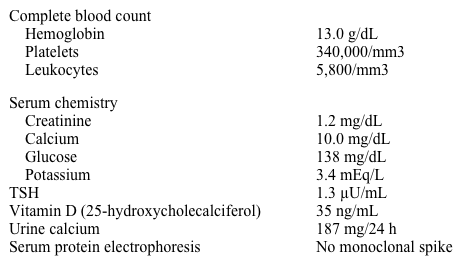
Thoracic spine radiograph shows a new T8 vertebral compression fracture.
Which of the following is the best next step in management of this patient?
A) Add nasal calcitonin
B) Check anti-tissue transglutaminase antibodies
C) Perform bone marrow biopsy
D) Perform overnight dexamethasone suppression test
E) Switch to teriparatide
Correct Answer:

Verified
Q234: A 47-year-old man comes to the physician
Q235: A 56-year-old woman with colon cancer diagnosed
Q236: A 26-year-old woman comes to the physician
Q237: A 43-year-old woman comes to the emergency
Q238: A 51-year-old woman comes to the physician
Q240: A 51-year-old woman comes to the office
Q241: A 34-year-old woman comes to the office
Q242: A 71-year-old man comes to the physician
Q243: A 36-year-old woman comes to the office
Q244: A 27-year-old man comes to the physician
Unlock this Answer For Free Now!
View this answer and more for free by performing one of the following actions

Scan the QR code to install the App and get 2 free unlocks

Unlock quizzes for free by uploading documents