A 50-year-old man comes to the physician with the complaint of weakness. He was well until about 3 weeks ago when he had several episodes of diarrhea that lasted 4 days. Seven days ago, he felt shooting pains in his feet and legs followed by bilateral leg weakness. He reports difficulty with ambulation and getting out of a chair. He has no fever, chills, vision changes, dysphagia, bladder or bowel problems, back pain, muscle tenderness, or dark urine. His past medical history includes hypertension and hyperlipidemia. His current medications include hydrochlorothiazide and lovastatin.
His blood pressure is 144/86 mm Hg, and pulse is 90/min and regular. Physical examination reveals marked symmetrical weakness of both legs without sensory deficits. Lower-extremity deep-tendon reflexes are absent. There is slight symmetric weakness of his hands, but strength and deep-tendon reflexes of his proximal upper extremities are intact. Cranial nerves are intact. The remainder of the examination is within normal limits.
Laboratory results are as follows: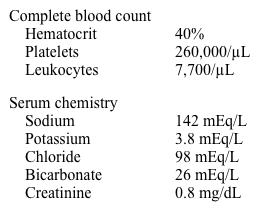
Which of the following is the most likely finding on cerebrospinal fluid analysis?
A) Protein 34 mg/dL, leukocytes 3 cells/mm3
B) Protein 45 mg/dL, leukocytes 89 cells/mm3
C) Protein 100 mg/dL, leukocytes 4 cells/mm3
D) Protein 120 mg/dL, leukocytes 76 cells/mm3
E) Protein 210 mg/dL, leukocytes 3400 cells/mm3
Correct Answer:

Verified
Q555: An 18-year-old woman comes to the physician
Q556: A 35-year-old woman comes to the physician
Q557: A 74-year-old woman comes to the office
Q558: A 59-year-old man with a long history
Q559: A 70-year-old woman comes to the office
Q561: A 35-year-old man comes to the office
Q562: A 38-year-old woman comes to the physician
Q563: A 67-year-old woman with stable angina pectoris
Q564: A 79-year-old woman is brought to the
Q565: A 45-year-old man complains of decreased hearing
Unlock this Answer For Free Now!
View this answer and more for free by performing one of the following actions

Scan the QR code to install the App and get 2 free unlocks

Unlock quizzes for free by uploading documents