A 38-year-old woman comes to the physician with left facial numbness and paresthesias for the last 3 days. She is a known intravenous drug user. One month ago, she had an episode of blurry vision in her right eye and vertigo that resolved spontaneously. One year ago, she was admitted to the hospital with fever to rule out endocarditis. Transesophageal echocardiography at that time showed no vegetations but did demonstrate a small secundum-type atrial septal defect. The patient's past medical history is also significant for hypothyroidism, migraine disorder, and hypertension.
Her temperature is 37.2 C (99 F) , blood pressure is 140/88 mm Hg, and pulse is 85/min. Her body mass index is 28 kg/m2. The patient is awake and in mild distress. Examination shows a pale right optic disc, right relative afferent pupillary defect, and reduced sensation on the left side of the face. Motor examination shows a slight pronator drift in the right upper extremity with increased tone and hyperreflexia. She also has mild dysmetria in the left upper extremity.
MRI of the brain with and without gadolinium is performed; the T2/FLAIR sequence is shown in the image below.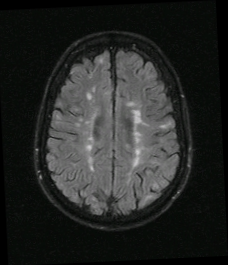
Which of the following would be most helpful in confirming the diagnosis in this patient?
A) Brain biopsy
B) HIV testing
C) Lumbar puncture
D) MR angiography of the brain
E) Transesophageal echocardiogram
Correct Answer:

Verified
Q557: A 74-year-old woman comes to the office
Q558: A 59-year-old man with a long history
Q559: A 70-year-old woman comes to the office
Q560: A 50-year-old man comes to the physician
Q561: A 35-year-old man comes to the office
Q563: A 67-year-old woman with stable angina pectoris
Q564: A 79-year-old woman is brought to the
Q565: A 45-year-old man complains of decreased hearing
Q566: A 65-year-old man comes to the physician
Q567: A 60-year-old man with long-standing type 2
Unlock this Answer For Free Now!
View this answer and more for free by performing one of the following actions

Scan the QR code to install the App and get 2 free unlocks

Unlock quizzes for free by uploading documents