A 72-year-old man presents with 4 weeks of central low back pain. His pain was initially mild and relieved by recumbency. Over the past two weeks, the pain has increased in severity and occurs at night without relief by lying down. The pain does not radiate and he has neither sensory loss nor weakness in his legs.
The patient has benign prostatic hyperplasia with significant outlet obstruction. He is scheduled for a transurethral prostatectomy soon. He was treated for a urinary tract infection both 3 years ago and two months ago. He has a history of stable coronary artery disease, hypertension, and degenerative joint disease. He has no history of cancer.
His temperature is 37.8 C (100.1 F) , blood pressure is 140/72 mm Hg, and pulse is 84/min. Cardiac, pulmonary, and abdominal exams are unremarkable. There is decreased range of motion in all aspects of his back. Point tenderness is present over the third and fourth lumbar processes. There are no sensory or motor deficits in his lower extremities. Deep tendon reflexes are symmetric. Perineal sensation and rectal tone are normal. An enlarged, non-tender rubbery prostate is palpated on digital rectal examination.
The patient's labs reveal: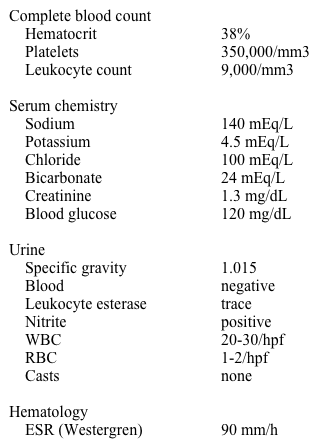
Which of the following is the most appropriate next step in management?
A) Ibuprofen and activity as tolerated
B) MRI of the lower spine
C) Oxycodone with acetaminophen for 2 weeks
D) Prostate biopsy
E) Serum protein electrophoresis
Correct Answer:

Verified
Q805: A 63-year-old man, who was diagnosed with
Q806: A 57-year-old woman comes to the physician
Q807: 43-year-old attorney comes to the office because
Q808: A 72-year-old woman comes to the physician
Q809: A 69-year-old man comes to the office
Q811: A 35-year-old man comes to the office
Q812: A 75-year-old woman comes to the office
Q813: A 73-year-old woman comes to the office
Q814: A 33-year-old woman comes to the office
Q815: A 78-year-old retired professor comes to the
Unlock this Answer For Free Now!
View this answer and more for free by performing one of the following actions

Scan the QR code to install the App and get 2 free unlocks

Unlock quizzes for free by uploading documents