A 72-year-old woman comes to the physician because of aching and stiffness of her neck and shoulders for the past several weeks. This stiffness lasts for 1-2 hours after rising in the morning. She has tried ibuprofen without relief and has also experienced increasing fatigue for 4-6 weeks. She has no visual changes, headaches, other joint complaints, fever, or chills. Her weight is stable. The patient has osteoporosis, hyperlipidemia, type 2 diabetes mellitus, and hypertension. Current medications include metformin, chlorthalidone, lisinopril, atorvastatin, and calcium and vitamin D supplements.
On physical examination, she appears to be in no acute distress. Her temperature is 37.1 C (98.8 F) , pulse is 84/min, blood pressure is 130/84 mm Hg, and respiratory rate is 16/min. There is some limitation in range of motion of her shoulders and neck. There is no cervical muscle tenderness, no upper or lower extremity proximal muscle weakness, and no joint swelling or redness.
The patient's laboratory results are as follows: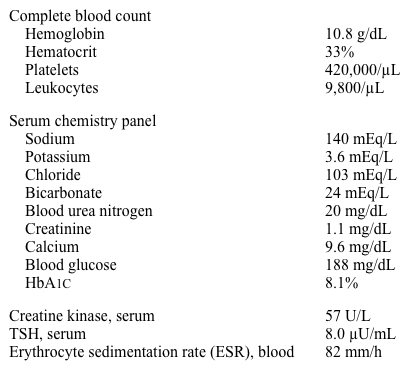
Which of the following is the most likely cause of this patient's condition?
A) Diabetic amyotrophy
B) Fibromyalgia
C) Hypothyroidism
D) Medication side effect
E) Polymyalgia rheumatica
Correct Answer:

Verified
Q803: A 70-year-old man comes to the physician
Q804: A 60-year-old woman comes to the office
Q805: A 63-year-old man, who was diagnosed with
Q806: A 57-year-old woman comes to the physician
Q807: 43-year-old attorney comes to the office because
Q809: A 69-year-old man comes to the office
Q810: A 72-year-old man presents with 4 weeks
Q811: A 35-year-old man comes to the office
Q812: A 75-year-old woman comes to the office
Q813: A 73-year-old woman comes to the office
Unlock this Answer For Free Now!
View this answer and more for free by performing one of the following actions

Scan the QR code to install the App and get 2 free unlocks

Unlock quizzes for free by uploading documents