A 73-year-old woman comes to the office because of achiness. She began to notice pain around her shoulders and hips six weeks ago. The symptoms developed abruptly without an antecedent illness. She notes considerable stiffness around her neck and shoulders in the morning when she gets out of bed and has difficulty dressing herself. She has some soreness in both hips, but these symptoms slowly clear by midday. She denies any cranial complaints. She has never had similar muscle or joint achiness before. She has no fever, chills, weight loss, or headache. She tried over-the-counter ibuprofen, which did not relieve her pain.
Her past medical history is notable for hypertension, hyperlipidemia, coronary artery disease, transient ischemic attack. Her medications include aspirin, hydrochlorothiazide, hydralazine, isosorbide, a statin, and a beta blocker. She has had no medication changes in the last year. She is allergic to angiotensin converting enzyme inhibitors.
Physical examination is within normal limits except for some mild restriction of bilateral shoulder abduction. She does not have any swollen joints.
Her laboratory results are as follows: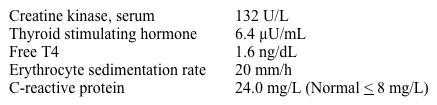
Her complete blood count, serum electrolytes, and liver and kidney function studies are normal.
Which of the following is the most appropriate next step in management?
A) Discontinue hydralazine
B) Discontinue statin medication
C) Prescribe amitriptyline at bedtime
D) Start low-dose levothyroxine
E) Start low-dose prednisone
Correct Answer:

Verified
Q808: A 72-year-old woman comes to the physician
Q809: A 69-year-old man comes to the office
Q810: A 72-year-old man presents with 4 weeks
Q811: A 35-year-old man comes to the office
Q812: A 75-year-old woman comes to the office
Q814: A 33-year-old woman comes to the office
Q815: A 78-year-old retired professor comes to the
Q816: A 65-year-old woman comes to the physician
Q817: A 70-year-old woman comes to the office
Q818: A 75-year-old man comes to the physician
Unlock this Answer For Free Now!
View this answer and more for free by performing one of the following actions

Scan the QR code to install the App and get 2 free unlocks

Unlock quizzes for free by uploading documents