A 79-year-old woman is brought to the emergency department by her daughter due to bloody stools. The patient has a 3-day history of occasionally passing blood with her stools but this morning she filled up the toilet bowl with bloody stools. She has not had another bowel movement since. She does not have any associated symptoms such as nausea, vomiting, or abdominal pain. Her past medical history includes mild dementia, hypertension, diet-controlled diabetes mellitus, and osteoarthritis. She does not smoke or drink alcohol. The patient takes a baby aspirin daily and nonsteroidal anti-inflammatory agents occasionally for hip pain. Her temperature is 36.7 C (98 F) , heart rate is 89/min, blood pressure is 146/82 mm Hg, and respiratory rate is 16/min. She appears pale. Abdominal examination is unremarkable. Rectal examination reveals bright red blood in the rectal vault, without tenderness. Nasogastric aspirate shows copious amounts of bilious fluid. Laboratory results are as follows: 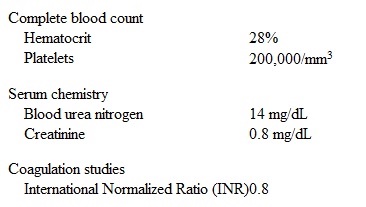 She is started on intravenous fluids and blood work is ordered including blood type and cross-match. Which of the following is the most appropriate next step in the management of this patient?
A) Arrange for colonoscopy
B) Arrange for upper gastrointestinal endoscopy
C) Order non-contrast CT scan of the abdomen
D) Perform angiography
E) Start octreotide drip
Correct Answer:

Verified
Q389: A 58-year-old obese woman comes to the
Q390: A 39-year-old man comes to the outpatient
Q391: A 4-month-old boy is brought to the
Q392: A 31-year-old man comes to the office
Q393: A 42-year-old woman comes to the office
Q395: A 55-year-old man is brought to the
Q396: An 82-year-old woman is brought to the
Q397: A 2-year-old boy is brought to the
Q398: A 35-year-old woman, gravida 2 para 1,
Q399: A 67-year-old woman comes to the office
Unlock this Answer For Free Now!
View this answer and more for free by performing one of the following actions

Scan the QR code to install the App and get 2 free unlocks

Unlock quizzes for free by uploading documents