Solved

A 9-Year-Old Boy Is Brought to the Office by His

Question 571

Multiple Choice

A 9-year-old boy is brought to the office by his parents due to knee pain.  His mother states, "He started having occasional left knee pain with mild swelling 2 weeks ago, but the pain and swelling have worsened over the last 5 days."  The patient plays basketball but has had no recent trauma.  Last week, he had a runny nose and sore throat that resolved on their own.  The patient has had no fever, headaches, or chest pain.  His mother notes that he has been sleeping "a little more than usual" over the last month.  The patient recalls a tick bite 3 months ago during a camping trip in Pennsylvania.  He does not remember developing a rash at that time.  The patient has congenital hearing loss for which he wears a hearing aid.  He takes no daily medications and has no known allergies.  Temperature is 36.7 C (98 F) and blood pressure is 100/70 mm Hg.  Physical examination shows a well-appearing child with a moderately swollen, warm, and mildly tender left knee.  There is no erythema.  Minimal pain is elicited with full extension of the knee.  The patient is able to stand and bear weight.  Sensation is intact.  Capillary refill in the bilateral lower extremities is brisk.  There is a small bruise on his right knee but no rashes or petechiae.  Laboratory results are as follows:
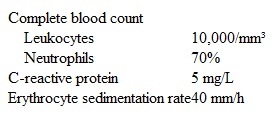
A 9-year-old boy is brought to the office by his parents due to knee pain.  His mother states,  He started having occasional left knee pain with mild swelling 2 weeks ago, but the pain and swelling have worsened over the last 5 days.   The patient plays basketball but has had no recent trauma.  Last week, he had a runny nose and sore throat that resolved on their own.  The patient has had no fever, headaches, or chest pain.  His mother notes that he has been sleeping  a little more than usual  over the last month.  The patient recalls a tick bite 3 months ago during a camping trip in Pennsylvania.  He does not remember developing a rash at that time.  The patient has congenital hearing loss for which he wears a hearing aid.  He takes no daily medications and has no known allergies.  Temperature is 36.7 C (98 F)  and blood pressure is 100/70 mm Hg.  Physical examination shows a well-appearing child with a moderately swollen, warm, and mildly tender left knee.  There is no erythema.  Minimal pain is elicited with full extension of the knee.  The patient is able to stand and bear weight.  Sensation is intact.  Capillary refill in the bilateral lower extremities is brisk.  There is a small bruise on his right knee but no rashes or petechiae.  Laboratory results are as follows:   A left knee arthrocentesis is performed, and synovial fluid analysis reveals a white blood cell count of 24,000/mm³ with 85% neutrophils. Left knee arthrocentesis relieves the patient's swelling, and he is now able to walk almost normally.  After 3 days, the patient returns for a follow-up visit.  His parents are concerned about his ability to participate in sports.  A mild effusion is present on left knee examination.  Laboratory results are as follows:   Which of the following is the most accurate description regarding this patient's prognosis? A) Most patients are disease-free after oral antibiotic therapy B) Parenteral antibiotic therapy is necessary to prevent long-term sequelae C) Patients can resume normal activity after arthrocentesis D) Patients require monthly antibiotic therapy for prevention of recurrent disease E) Recurrent episodes of arthritis are common and require anti-inflammatory treatment A left knee arthrocentesis is performed, and synovial fluid analysis reveals a white blood cell count of 24,000/mm³ with 85% neutrophils.
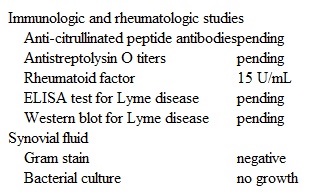
Left knee arthrocentesis relieves the patient's swelling, and he is now able to walk almost normally.  After 3 days, the patient returns for a follow-up visit.  His parents are concerned about his ability to participate in sports.  A mild effusion is present on left knee examination.  Laboratory results are as follows:
A 9-year-old boy is brought to the office by his parents due to knee pain.  His mother states,  He started having occasional left knee pain with mild swelling 2 weeks ago, but the pain and swelling have worsened over the last 5 days.   The patient plays basketball but has had no recent trauma.  Last week, he had a runny nose and sore throat that resolved on their own.  The patient has had no fever, headaches, or chest pain.  His mother notes that he has been sleeping  a little more than usual  over the last month.  The patient recalls a tick bite 3 months ago during a camping trip in Pennsylvania.  He does not remember developing a rash at that time.  The patient has congenital hearing loss for which he wears a hearing aid.  He takes no daily medications and has no known allergies.  Temperature is 36.7 C (98 F)  and blood pressure is 100/70 mm Hg.  Physical examination shows a well-appearing child with a moderately swollen, warm, and mildly tender left knee.  There is no erythema.  Minimal pain is elicited with full extension of the knee.  The patient is able to stand and bear weight.  Sensation is intact.  Capillary refill in the bilateral lower extremities is brisk.  There is a small bruise on his right knee but no rashes or petechiae.  Laboratory results are as follows:   A left knee arthrocentesis is performed, and synovial fluid analysis reveals a white blood cell count of 24,000/mm³ with 85% neutrophils. Left knee arthrocentesis relieves the patient's swelling, and he is now able to walk almost normally.  After 3 days, the patient returns for a follow-up visit.  His parents are concerned about his ability to participate in sports.  A mild effusion is present on left knee examination.  Laboratory results are as follows:   Which of the following is the most accurate description regarding this patient's prognosis? A) Most patients are disease-free after oral antibiotic therapy B) Parenteral antibiotic therapy is necessary to prevent long-term sequelae C) Patients can resume normal activity after arthrocentesis D) Patients require monthly antibiotic therapy for prevention of recurrent disease E) Recurrent episodes of arthritis are common and require anti-inflammatory treatment Which of the following is the most accurate description regarding this patient's prognosis?


A) Most patients are disease-free after oral antibiotic therapy
B) Parenteral antibiotic therapy is necessary to prevent long-term sequelae
C) Patients can resume normal activity after arthrocentesis
D) Patients require monthly antibiotic therapy for prevention of recurrent disease
E) Recurrent episodes of arthritis are common and require anti-inflammatory treatment

Correct Answer:

verifed

Verified

Unlock this answer now
Get Access to more Verified Answers free of charge

Related Questions

Unlock this Answer For Free Now!

View this answer and more for free by performing one of the following actions

qr-code

Scan the QR code to install the App and get 2 free unlocks

upload documents

Unlock quizzes for free by uploading documents