A 3-year-old girl is brought to the emergency department due to pain and fever. Two days ago, she developed mild abdominal and back pain. Her fever began yesterday morning and reached a maximum of 40.1 C (104.2 F) last night. Over the last 8 hours, she had 6 episodes of emesis but has since tolerated a few sips of water. The girl has a history of constipation since the start of toilet training at age 2 and has "pellet-like" stools once a week. She has frequent urinary accidents during the day and night. She takes no medications and has no other medical problems. Immunizations are up to date. Temperature is 40 C (104 F) , blood pressure is 90/60 mm Hg, pulse is 110/min, and respirations are 20/min. Physical examination shows a tired-appearing girl with dry mucous membranes. She has right costovertebral tenderness. The abdomen is soft, nontender, and nondistended. The remainder of the examination is unremarkable. Laboratory results are as follows: 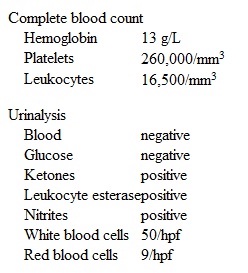 A 20-mL/kg normal saline bolus is administered. The patient has another episode of emesis and an additional void in the emergency department. The patient is admitted to the hospital, and intravenous antibiotics are started. Urine culture is positive for pansensitive Escherichia coli. Blood culture is negative. After 48 hours, the patient is tolerating oral fluids and is afebrile. The patient is discharged from the hospital on oral antibiotics. Which of the following should be recommended to prevent recurrence of this patient's infection?
A) Enuresis alarm therapy
B) Laxative therapy
C) No treatment is recommended
D) Prophylactic antibiotic therapy
E) Repeat urine culture
Correct Answer:

Verified
Q618: A 52-year-old man comes to the office
Q619: A 24-year-old woman, gravida 1 para 0,
Q620: A 25-year-old man comes to the employee
Q621: A 26-year-old woman comes to the office
Q622: A 46-year-old man comes to the office
Q624: A 58-year-old man comes to the office
Q625: A 9-month-old boy is brought to the
Q626: A 55-year-old man comes to the emergency
Q627: A 7-month-old boy is brought to the
Q628: A 42-year-old man comes to the office
Unlock this Answer For Free Now!
View this answer and more for free by performing one of the following actions

Scan the QR code to install the App and get 2 free unlocks

Unlock quizzes for free by uploading documents