Solved

A 79-Year-Old Woman Is Hospitalized After a Fall That Resulted

Question 968

Multiple Choice

A 79-year-old woman is hospitalized after a fall that resulted in a left femoral neck fracture.  She tripped over her dog while cleaning her home, hit her head on a bookshelf, and landed on her left side.  Prior to this she had been in her usual state of health; her other medical issues include obesity, type 2 diabetes mellitus, hypertension, chronic kidney disease, and hypothyroidism.  The patient lives at home by herself.  She has smoked a pack of cigarettes daily for 38 years.  She drinks alcohol every weekend.  Results of the patient's initial workup in the emergency department demonstrated the left femoral neck fracture, creatinine of 2.0 mg/dL, and a negative noncontrast head CT.  She was admitted to the hospital and the following day underwent surgical repair.  The procedure was uncomplicated.  However, on postoperative day 3 the patient is noted to be uncomfortable and mildly agitated.  She is unable to coherently explain her symptoms.  Current medications include prophylactic subcutaneous heparin, insulin glargine, omeprazole, hydrocodone, and levothyroxine.  Temperature is 37.7 C (99.9 F) , blood pressure is 104/68 mm Hg, pulse is 114/min, and respirations are 28/min.  Pulse oximetry is 86% on room air.  Examination shows equal round and reactive pupils.  Lung examination demonstrates decreased breath sounds at the bilateral bases.  Heart rhythm is regular with normal S1 and S2.  The surgical incision shows no surrounding erythema or purulent drainage.  The patient follows commands and moves all extremities except the left leg.  Laboratory results are as follows:
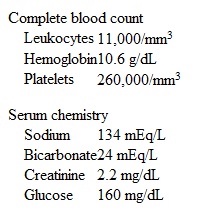
A 79-year-old woman is hospitalized after a fall that resulted in a left femoral neck fracture.  She tripped over her dog while cleaning her home, hit her head on a bookshelf, and landed on her left side.  Prior to this she had been in her usual state of health; her other medical issues include obesity, type 2 diabetes mellitus, hypertension, chronic kidney disease, and hypothyroidism.  The patient lives at home by herself.  She has smoked a pack of cigarettes daily for 38 years.  She drinks alcohol every weekend.  Results of the patient's initial workup in the emergency department demonstrated the left femoral neck fracture, creatinine of 2.0 mg/dL, and a negative noncontrast head CT.  She was admitted to the hospital and the following day underwent surgical repair.  The procedure was uncomplicated.  However, on postoperative day 3 the patient is noted to be uncomfortable and mildly agitated.  She is unable to coherently explain her symptoms.  Current medications include prophylactic subcutaneous heparin, insulin glargine, omeprazole, hydrocodone, and levothyroxine.  Temperature is 37.7 C (99.9 F) , blood pressure is 104/68 mm Hg, pulse is 114/min, and respirations are 28/min.  Pulse oximetry is 86% on room air.  Examination shows equal round and reactive pupils.  Lung examination demonstrates decreased breath sounds at the bilateral bases.  Heart rhythm is regular with normal S1 and S2.  The surgical incision shows no surrounding erythema or purulent drainage.  The patient follows commands and moves all extremities except the left leg.  Laboratory results are as follows:   Troponin I is undetectable.  Chest x-ray shows slight bibasilar atelectasis without focal consolidation, pleural effusion, or pulmonary edema.  ECG shows sinus tachycardia but is otherwise unremarkable. Ventilation-perfusion scan shows high probability for pulmonary embolism.  The patient is started on intravenous heparin.  The next day, the nurse reports that the patient has a fever.  The patient still has some chest pain but her shortness of breath and mental status are improved.  There is no cough, abdominal pain, nausea, vomiting, diarrhea, dysuria, urinary frequency, or headache.  Temperature is 38.3 C (101 F) , blood pressure is 121/73 mm Hg, pulse is 102/min, and respirations are 22/min.  Oxygen saturation is 92% on 2 L of oxygen by nasal cannula.  She does not appear ill.  The lungs are clear to auscultation.  The abdomen is soft and nontender.  Neurologic examination is nonfocal.  The operative site is healing well without erythema or purulence.  The patient's 2 peripheral IV lines have no evidence of infection.  Indwelling urinary catheter is draining clear yellow urine.  Laboratory results are as follows:   Chest x-ray shows no new abnormalities.  Urinalysis is normal.  Blood cultures are sent.  Which of the following would be the most appropriate next step for this patient? A) Continue to monitor on current therapy B) Initiate antibiotic therapy for community-acquired pneumonia C) Initiate antibiotic therapy for hospital-acquired pneumonia D) Send stool for Clostridium difficile PCR E) Start empiric antibiotic therapy for bloodstream infection Troponin I is undetectable.  Chest x-ray shows slight bibasilar atelectasis without focal consolidation, pleural effusion, or pulmonary edema.  ECG shows sinus tachycardia but is otherwise unremarkable.
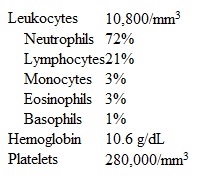
Ventilation-perfusion scan shows high probability for pulmonary embolism.  The patient is started on intravenous heparin.  The next day, the nurse reports that the patient has a fever.  The patient still has some chest pain but her shortness of breath and mental status are improved.  There is no cough, abdominal pain, nausea, vomiting, diarrhea, dysuria, urinary frequency, or headache.  Temperature is 38.3 C (101 F) , blood pressure is 121/73 mm Hg, pulse is 102/min, and respirations are 22/min.  Oxygen saturation is 92% on 2 L of oxygen by nasal cannula.  She does not appear ill.  The lungs are clear to auscultation.  The abdomen is soft and nontender.  Neurologic examination is nonfocal.  The operative site is healing well without erythema or purulence.  The patient's 2 peripheral IV lines have no evidence of infection.  Indwelling urinary catheter is draining clear yellow urine.  Laboratory results are as follows:
A 79-year-old woman is hospitalized after a fall that resulted in a left femoral neck fracture.  She tripped over her dog while cleaning her home, hit her head on a bookshelf, and landed on her left side.  Prior to this she had been in her usual state of health; her other medical issues include obesity, type 2 diabetes mellitus, hypertension, chronic kidney disease, and hypothyroidism.  The patient lives at home by herself.  She has smoked a pack of cigarettes daily for 38 years.  She drinks alcohol every weekend.  Results of the patient's initial workup in the emergency department demonstrated the left femoral neck fracture, creatinine of 2.0 mg/dL, and a negative noncontrast head CT.  She was admitted to the hospital and the following day underwent surgical repair.  The procedure was uncomplicated.  However, on postoperative day 3 the patient is noted to be uncomfortable and mildly agitated.  She is unable to coherently explain her symptoms.  Current medications include prophylactic subcutaneous heparin, insulin glargine, omeprazole, hydrocodone, and levothyroxine.  Temperature is 37.7 C (99.9 F) , blood pressure is 104/68 mm Hg, pulse is 114/min, and respirations are 28/min.  Pulse oximetry is 86% on room air.  Examination shows equal round and reactive pupils.  Lung examination demonstrates decreased breath sounds at the bilateral bases.  Heart rhythm is regular with normal S1 and S2.  The surgical incision shows no surrounding erythema or purulent drainage.  The patient follows commands and moves all extremities except the left leg.  Laboratory results are as follows:   Troponin I is undetectable.  Chest x-ray shows slight bibasilar atelectasis without focal consolidation, pleural effusion, or pulmonary edema.  ECG shows sinus tachycardia but is otherwise unremarkable. Ventilation-perfusion scan shows high probability for pulmonary embolism.  The patient is started on intravenous heparin.  The next day, the nurse reports that the patient has a fever.  The patient still has some chest pain but her shortness of breath and mental status are improved.  There is no cough, abdominal pain, nausea, vomiting, diarrhea, dysuria, urinary frequency, or headache.  Temperature is 38.3 C (101 F) , blood pressure is 121/73 mm Hg, pulse is 102/min, and respirations are 22/min.  Oxygen saturation is 92% on 2 L of oxygen by nasal cannula.  She does not appear ill.  The lungs are clear to auscultation.  The abdomen is soft and nontender.  Neurologic examination is nonfocal.  The operative site is healing well without erythema or purulence.  The patient's 2 peripheral IV lines have no evidence of infection.  Indwelling urinary catheter is draining clear yellow urine.  Laboratory results are as follows:   Chest x-ray shows no new abnormalities.  Urinalysis is normal.  Blood cultures are sent.  Which of the following would be the most appropriate next step for this patient? A) Continue to monitor on current therapy B) Initiate antibiotic therapy for community-acquired pneumonia C) Initiate antibiotic therapy for hospital-acquired pneumonia D) Send stool for Clostridium difficile PCR E) Start empiric antibiotic therapy for bloodstream infection Chest x-ray shows no new abnormalities.  Urinalysis is normal.  Blood cultures are sent.  Which of the following would be the most appropriate next step for this patient?


A) Continue to monitor on current therapy
B) Initiate antibiotic therapy for community-acquired pneumonia
C) Initiate antibiotic therapy for hospital-acquired pneumonia
D) Send stool for Clostridium difficile PCR
E) Start empiric antibiotic therapy for bloodstream infection

Correct Answer:

verifed

Verified

Unlock this answer now
Get Access to more Verified Answers free of charge

Related Questions

Unlock this Answer For Free Now!

View this answer and more for free by performing one of the following actions

qr-code

Scan the QR code to install the App and get 2 free unlocks

upload documents

Unlock quizzes for free by uploading documents