A 48-year-old man is brought to the emergency department for what his wife describes as "bizarre behavior" for the last two days. His past medical history is significant for cirrhosis secondary to chronic hepatitis C infection. His daily medications are spironolactone, lactulose, and furosemide. He is an ex-heroin user. Examination shows a drowsy but restless patient. His blood pressure is 94/56 mmHg and heart rate is 112/min with a regular rhythm. The abdomen is distended, soft, and non-tender to palpation. Shifting dullness is present. There is no peripheral edema. Laboratory tests show the following: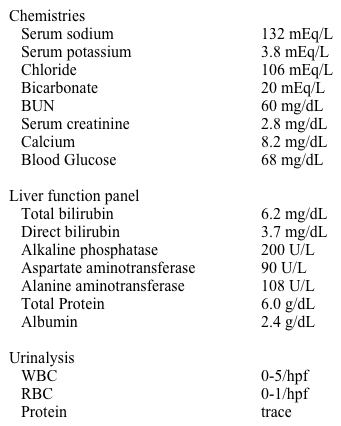 The peritoneal fluid is sampled yielding 12 WBCs/mm3 and an albumin of 1.0 mg/dL. Renal ultrasound shows no evidence of hydronephrosis. Which of the following is the best next step in managing this patient?
A) High-dose corticosteroids
B) Intravenous loop diuretics
C) Low-dose intravenous dopamine
D) Renal biopsy
E) Intravascular volume expansion
Correct Answer:

Verified
Q959: A 32-year-old man is brought to the
Q960: A physician receives a call from a
Q961: A 34-year-old man comes to the emergency
Q962: A 6-year-old boy is brought to the
Q963: A 6-year-old boy is brought to the
Q965: A 42-year-old man comes to the emergency
Q966: A newborn girl is evaluated in the
Q967: A 59-year-old man comes to the office
Q968: A 79-year-old woman is hospitalized after a
Q969: A 54-year-old man comes to the emergency
Unlock this Answer For Free Now!
View this answer and more for free by performing one of the following actions

Scan the QR code to install the App and get 2 free unlocks

Unlock quizzes for free by uploading documents