A 54-year-old man comes to the emergency department after an episode of syncope. While he was watching television 30 minutes ago, he experienced sudden-onset chest pressure followed by a syncopal episode. He regained consciousness within a minute but continues to have chest "heaviness" and shortness of breath. Two days ago, the patient returned home from an extended car trip. He has a history of hypertension, osteoarthritis, and prostate cancer treated with brachytherapy. He is a former smoker with a 15-pack-year history and does not use alcohol or illicit drugs. Temperature is 38.3 C (100.9 F) , blood pressure is 81/50 mm Hg, pulse is 110/min and regular, respirations are 26/min, and pulse oximetry is 92% on room air. The lungs are clear to auscultation. Cardiac examination shows a nondisplaced point of maximal impulse, with no murmurs but an accentuated pulmonic component of S2. Laboratory results are as follows: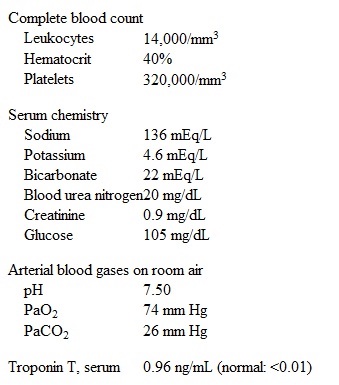 ECG shows sinus tachycardia with nonspecific ST-segment and T-wave changes. CT angiography reveals filling defects in the bilateral main pulmonary arteries. Blood pressure after multiple fluid boluses is 85/60 mm Hg and pulse is 108/min.
The patient develops progressive hypoxemia requiring 100% supplemental oxygen via a nonrebreather mask, but even with treatment his respiratory distress worsens and he becomes progressively confused and lethargic. Endotracheal intubation is performed and mechanical ventilation is initiated. Intravenous norepinephrine infusion is started due to persistent hypotension. Bedside echocardiography reveals right ventricular dilation and hypokinesis, but left ventricular contractility is normal. Which of the following is the best next step in management of this patient?
A) Administer thrombolytic therapy
B) Begin milrinone to improve right ventricular function
C) Initiate intravenous heparin infusion
D) Perform low tidal volume ventilation
E) Place a retrievable inferior vena cava filter
Correct Answer:

Verified
Q964: A 48-year-old man is brought to the
Q965: A 42-year-old man comes to the emergency
Q966: A newborn girl is evaluated in the
Q967: A 59-year-old man comes to the office
Q968: A 79-year-old woman is hospitalized after a
Q970: A 54-year-old man comes to the emergency
Q971: A 24-year-old woman, gravida 1 para 0,
Q972: A 13-year-old boy comes to the office
Q973: A 17-year-old male presents to the office
Q974: A 54-year-old woman comes to the physician
Unlock this Answer For Free Now!
View this answer and more for free by performing one of the following actions

Scan the QR code to install the App and get 2 free unlocks

Unlock quizzes for free by uploading documents