Passage the N-Terminus of an Amino Acid Must Be Protected with with 9-Fluorenylmethoxycarbonyl
Passage
The N-terminus of an amino acid must be protected with 9-fluorenylmethoxycarbonyl (Fmoc) during solid state peptide synthesis to avoid side reactions (Scheme I) .
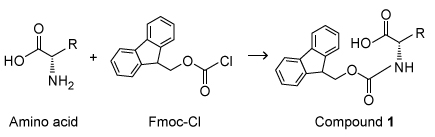 Scheme IThe Fmoc protecting group is typically removed with piperidine (Scheme II) , a heterocyclic secondary amine.
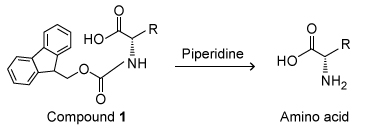 Scheme IIBecause the use of piperidine is restricted, structurally similar amines were examined as possible replacements. To determine whether piperidine analogues were suitable alternatives for Fmoc removal, deprotection of Compound 2 was carried out with several amine bases (Scheme III) .
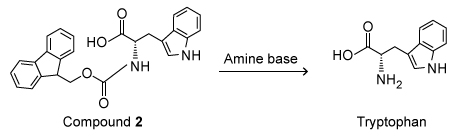 Scheme IIICompound 2 was prepared from L-tryptophan and Fmoc-Cl, and the reaction was monitored by thin-layer chromatography (TLC) and visualized by ultraviolet light. The deprotections were done with piperidine and each analogue using a microwave set to 155 watts at 75 °C for 15 seconds. The products of the deprotections were analyzed by high-performance liquid chromatography (HPLC) and mass spectrometry; the retention times of the products were compared to tryptophan and Compound 2 standards.
Adapted from O.P. Luna et al, "Deprotection Reagents in Fmoc Solid Phase Peptide Synthesis: Moving Away from Piperidine?." Molecules. ©2016 MDPI.
-Which of the following most accurately describes the process that occurs when visualizing the formation of the Compound 2 reaction mixture on a thin-layer chromatography plate?
A) Bound electrons fall to the ground state when absorbing UV light.
B) Bound electrons jump to an excited state when absorbing UV light.
C) Bound electrons remain at the same energy level when absorbing UV light.
D) Bound electrons fall to a lower-energy excited state when absorbing UV light.
Correct Answer:

Verified
Q147: Passage
The N-terminus of an amino acid must
Q148: A carboxylic acid is reacted with NaOH
Q149: Passage
Malaria is caused by the parasite Plasmodium
Q150: Passage
The protozoan Euglena gracilis expresses glycosyltransferases (enzymes
Q151: Thin-layer chromatography was used to determine the
Q153: Passage
The N-terminus of an amino acid must
Q154: The compound shown below has selected carbons
Q155: Passage
The N-terminus of an amino acid must
Q156: Four alkyl halides: bromomethane, 2-bromobutane, 2-bromo-2-methylpropane, and
Q157: Passage
Malaria is caused by the parasite Plasmodium
Unlock this Answer For Free Now!
View this answer and more for free by performing one of the following actions

Scan the QR code to install the App and get 2 free unlocks

Unlock quizzes for free by uploading documents