A 72-year-old man comes for evaluation of shortness of breath, headache, and fatigue. He has a history of hypertension, lives alone, and is not compliant with his medications. The patient drinks 1 or 2 glasses of wine daily but does not smoke. Blood pressure is 184/128 mm Hg, pulse is 96/min, and oxygen saturation is 90% by pulse oximetry on room air. He has early papilledema on funduscopic examination. Pulmonary examination shows bibasilar coarse crackles. Cardiac examination shows a grade 2/6 systolic ejection murmur along the left sternal border. There is trace pedal edema. Chest x-ray reveals mild pulmonary edema. An ECG is unchanged from prior tracings. Laboratory studies are normal except for serum creatinine of 2.0 mg/dL. The patient is given oxygen and furosemide and is started on a nitroprusside drip. After 36 hours, his blood pressure is 140/80 mm Hg and he is no longer dyspneic; however, he is confused and disoriented and has diffuse hyperreflexia. There are no other focal neurologic findings. Repeat laboratory results are as follows: 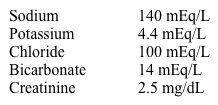 Which of the following is the most likely cause of this patient's current symptoms?
A) Alcohol withdrawal
B) Cyanide toxicity
C) Ischemic brain injury
D) Lacunar infarcts
E) Uremic encephalopathy
Correct Answer:

Verified
Q420: A 53-year-old man comes to the office
Q421: A 34-year-old woman comes to the emergency
Q422: A 64-year-old man is evaluated in the
Q423: A 65-year-old man comes to the emergency
Q424: A 42-year-old man is brought to the
Q426: A 19-year-old man is brought to the
Q427: A 57-year-old man arrives at the hospital
Q428: A 46-year-old man comes to the emergency
Q429: A 35-year-old man is brought to the
Q430: A 34-year-old man comes to the emergency
Unlock this Answer For Free Now!
View this answer and more for free by performing one of the following actions

Scan the QR code to install the App and get 2 free unlocks

Unlock quizzes for free by uploading documents