A 64-year-old man is evaluated in the hospital 24 hours after sustaining a pelvic fracture in a motor vehicle collision. Medical history includes chronic obstructive pulmonary disease. The patient has been receiving pain medications, blood transfusion, and prophylactic heparin. For the past 2 hours, he reports increasing shortness of breath. Temperature is 36.9 C (98.4 F) , blood pressure is 130/74 mm Hg, pulse is 112/min, and respirations are 24/min. Oxygen saturation is 87% on room air; it increases to 95% with 3 L oxygen. The patient is mildly disoriented. Pupils are small bilaterally. Lung sounds are clear bilaterally, and heart sounds are regular and without murmur or gallop. The abdomen is soft and nontender. The patient can move all 4 extremities, which are warm and pink. Petechiae are noted on the anterior chest and axillary areas. Chest x-ray is unremarkable. ECG shows sinus tachycardia but is otherwise normal. Laboratory results, including arterial blood gas analysis on room air, are as follows: 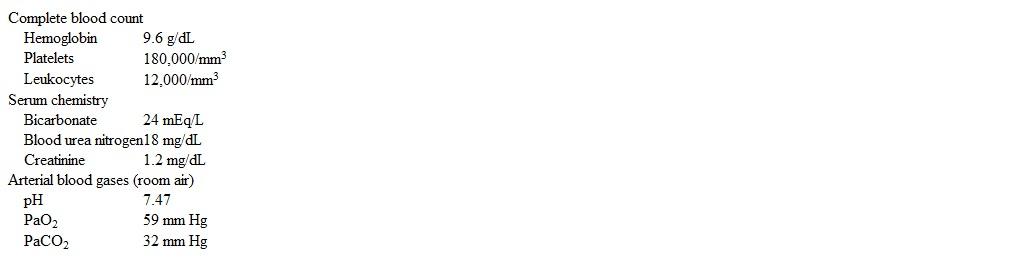 What is the best next step in management?
A) Albuterol and prednisone
B) Intubation and mechanical ventilation
C) Opioid discontinuation and naloxone
D) Supportive treatment only
E) Transthoracic echocardiography
Correct Answer:

Verified
Q417: A 32-year-old woman is evaluated for cough
Q418: A 3-year-old girl is brought to the
Q419: A 75-year-old man is brought to the
Q420: A 53-year-old man comes to the office
Q421: A 34-year-old woman comes to the emergency
Q423: A 65-year-old man comes to the emergency
Q424: A 42-year-old man is brought to the
Q425: A 72-year-old man comes for evaluation of
Q426: A 19-year-old man is brought to the
Q427: A 57-year-old man arrives at the hospital
Unlock this Answer For Free Now!
View this answer and more for free by performing one of the following actions

Scan the QR code to install the App and get 2 free unlocks

Unlock quizzes for free by uploading documents