A 57-year-old man arrives at the hospital with nausea, dark urine, and decreased urine output for 2 days. For the past week, the patient has had generalized fatigue, muscle pain, and weakness. He reports no recent fever, chills, sore throat, skin infection, or abdominal pain. Medical history is significant for coronary artery disease with stenting to the right coronary artery, hypertension, gout, and obstructive sleep apnea. Current medications include aspirin, ticagrelor, simvastatin, metoprolol, lisinopril, and colchicine. The patient does not use alcohol, tobacco, or illicit drugs. Temperature is 37 C (98.6 F) , blood pressure is 140/90 mm Hg, pulse is 88/min, and respirations are 18/min. There is no orthostasis. Skin turgor is normal. Oropharynx is clear. Cardiopulmonary examination shows no abnormalities. The abdomen is soft, nontender, and without bruit; there are no masses felt. There is no peripheral edema. The right great toe is slightly inflamed. Laboratory studies reveal the following: 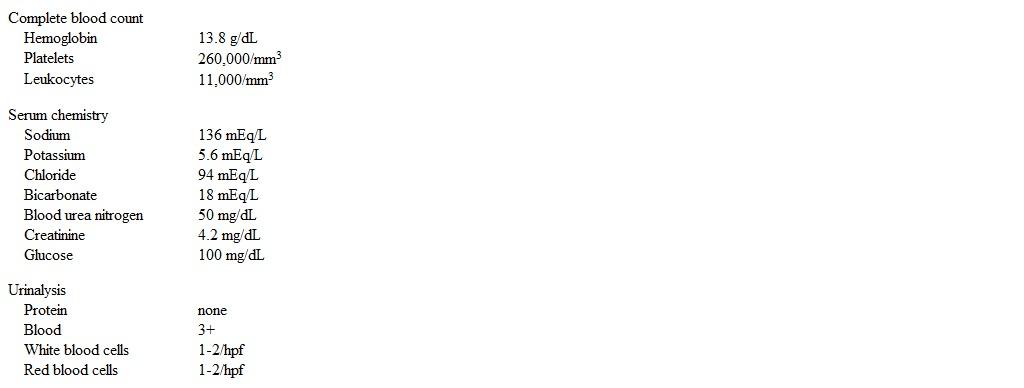 Baseline laboratory studies conducted a month ago were normal. Which of the following is most helpful to establish a diagnosis?
A) 24-hour urine protein measurement
B) Renal ultrasonogram
C) Renal vascular imaging
D) Serum complement levels
E) Serum creatine phosphokinase
Correct Answer:

Verified
Q422: A 64-year-old man is evaluated in the
Q423: A 65-year-old man comes to the emergency
Q424: A 42-year-old man is brought to the
Q425: A 72-year-old man comes for evaluation of
Q426: A 19-year-old man is brought to the
Q428: A 46-year-old man comes to the emergency
Q429: A 35-year-old man is brought to the
Q430: A 34-year-old man comes to the emergency
Q431: A 42-year-old man is brought to the
Q432: A 24-year-old woman is brought to the
Unlock this Answer For Free Now!
View this answer and more for free by performing one of the following actions

Scan the QR code to install the App and get 2 free unlocks

Unlock quizzes for free by uploading documents