A 46-year-old man comes to the emergency department due to a week of fever, chills, productive cough with yellow-white sputum, and shortness of breath. The patient received an allogenic renal transplantation 6 months ago and currently takes maintenance immunosuppressive therapy. He is a former smoker and works in a post office. Temperature is 39.4 C (102.9 F) , blood pressure is 110/65 mm Hg, pulse is 110/min, and respirations are 22/min. Lung auscultation reveals left upper lung crackles and bronchial breath sounds. Chest imaging reveals a left upper lobe nodular density with cavitation and nodular infiltrates in the right lung. Sputum Gram stain and culture are negative. Bronchoalveolar lavage cultures yield light growth of branching, filamentous rods that are partially acid-fast, as shown in the image below. Which of the following is the most likely causative organism of this patient's condition? 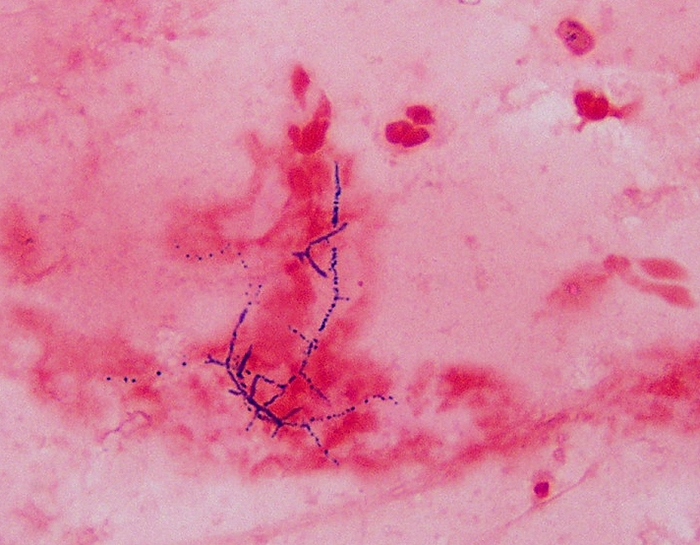
A) Actinomyces species
B) Aspergillus fumigatus
C) Bacillus anthracis
D) Klebsiella pneumoniae
E) Mycobacterium tuberculosis
F) Nocardia species
G) Peptostreptococcus
H) Streptococcus pyogenes
Correct Answer:

Verified
Q1289: A 30-year-old man comes to the office
Q1290: A 19-year-old college student comes to the
Q1291: A 57-year-old man who just returned from
Q1292: A 46-year-old man is brought to the
Q1293: A 44-year-old man comes to the clinic
Q1295: A 19-year-old man comes to the office
Q1296: A 62-year-old man is brought to the
Q1297: A 60-year-old man comes to the emergency
Q1298: A 46-year-old hospitalized man is evaluated for
Q1299: A 58-year-old man comes to the emergency
Unlock this Answer For Free Now!
View this answer and more for free by performing one of the following actions

Scan the QR code to install the App and get 2 free unlocks

Unlock quizzes for free by uploading documents