A 7-year-old boy is brought to the emergency department with nausea, vomiting, and abdominal pain. He has been increasingly tired for the past month and has experienced abdominal pain and nausea for the past 2 days. His temperature is 36.7 C (98 F) , blood pressure is 92/56 mm Hg, pulse is 134/min, and respirations are 24/min. Physical examination shows a tired but cooperative patient with dry mucous membranes. His lungs are clear to auscultation. The abdomen is soft, nondistended, and mildly tender in all quadrants. Bowel sounds are normal. There is no rebound or guarding. Laboratory results are as follows: 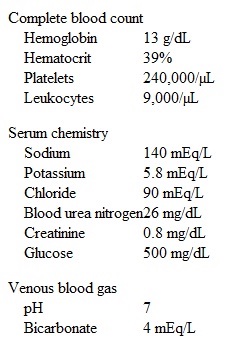 Urinalysis shows a specific gravity of 1.030, ketonuria, and glucosuria. A 10-mL/kg bolus of normal saline is administered intravenously over an hour. An insulin drip is then started. Which of the following is the most appropriate next step in management of this patient?
A) Add bicarbonate to the intravenous fluids
B) Admission to the intensive care unit
C) Antibiotic therapy
D) Blood and urine cultures
E) Serum lipase and abdominal CT scan
Correct Answer:

Verified
Q228: A 74-year-old man is brought to the
Q229: A 31-year-old man with diabetes comes to
Q230: A 58-year-old man comes to the physician
Q231: A 64-year-old woman comes to the physician
Q232: A 44-year-old male was found to have
Q234: A 68-year-old Caucasian female is brought to
Q235: A 72-year-old woman is brought to the
Q236: A 58-year-old woman comes to the office
Q237: A 28-year-old woman with type 1 diabetes
Q238: A 63-year-old man comes to the office
Unlock this Answer For Free Now!
View this answer and more for free by performing one of the following actions

Scan the QR code to install the App and get 2 free unlocks

Unlock quizzes for free by uploading documents