Passage
During the 19th century, the industrial revolution led to advances in health care in the United States that resulted in declines in the death rate followed by population growth. Around 1860, the U.S. birth rate also began to steadily decline until reaching its current plateau of about two births per woman during her lifetime. Since 1860, the U.S. birth rate has significantly increased during only one period: the post-World War II era known as the baby boom."Baby boomers," the generation of Americans born roughly between 1946 and 1964, are living longer than any prior generation, and their aging has evolving social and historical significance. By 2030, it is estimated that there will be about 61 million baby boomers in their eighties. In 1950, there were approximately seven times more producers (people age 15-64) than elderly (people age 65 and over) ; by 2030 there are projected to be less than three times more producers than elderly. Providing medical and social care to this aging cohort will have a major negative impact on the American economy due to the costs associated with health care and basic social services.Also impacting the U.S. population distribution is the fact that younger Americans (referred to as "millennials," born roughly between 1982 and 2004) are delaying marriage and children more so than any preceding generation, resulting in declining U.S. fertility rates. Figure 1 compares the U.S. population pyramid in 2000 to a projected population pyramid in 2030.
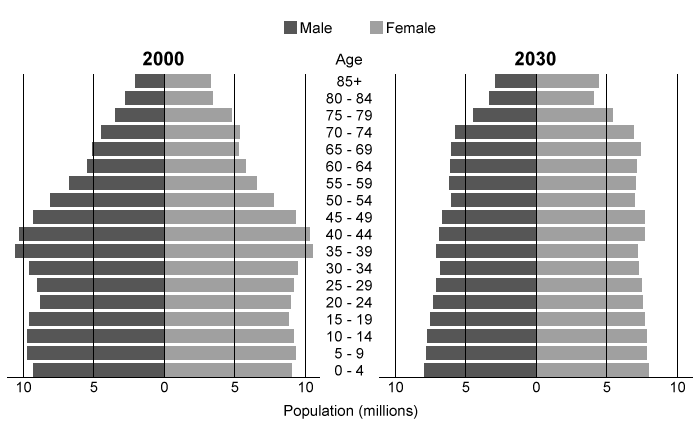 Figure 1 United States population pyramid from 2000 and a projected population pyramid for 2030
-Based on the information in the passage, a conflict theorist would suggest that the social significance of aging in America is best demonstrated by:
A) changing conceptions of "old age" as people live longer.
B) the relationship between doctors and their aging patients.
C) medicalization of aging by the medical and insurance industries.
D) competition between generations for the allocation of resources.
Correct Answer:

Verified
Q158: Passage
Jake and his classmate Michael both grew
Q159: Passage
Jake and his classmate Michael both grew
Q160: Passage
Physical modifications important for consolidating memory are
Q161: Passage
Text messaging while driving increases the risk
Q162: Passage
Text messaging while driving increases the risk
Q164: Passage
Although the terms sex, sex category, and
Q165: Passage
Text messaging while driving increases the risk
Q166: Passage
Physical modifications important for consolidating memory are
Q167: Passage
During the 19th century, the industrial revolution
Q168: Passage
Text messaging while driving increases the risk
Unlock this Answer For Free Now!
View this answer and more for free by performing one of the following actions

Scan the QR code to install the App and get 2 free unlocks

Unlock quizzes for free by uploading documents