Passage
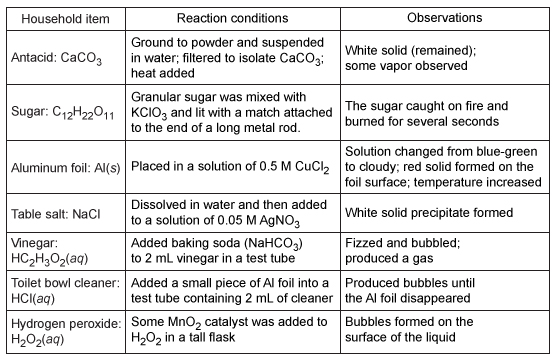
Students were asked to bring items from home to serve as examples for different types of reactions. The instructor provided additional reactants, solvents, heat, or a catalyst to demonstrate reactions with the household items.The students brought aluminum foil, table salt, sugar, baking soda, vinegar, toilet bowl cleaner, hydrogen peroxide, and antacid tablets.Experiment 1Reactions were performed using the household items. The reaction conditions and student observations are recorded in Table 1.Table 1 Reaction Conditions and Visual Observations
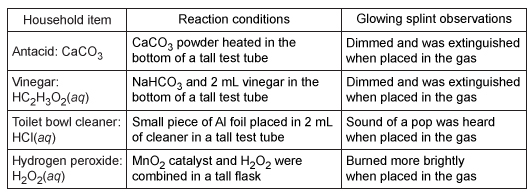
 Experiment 2The reactions that were observed to produce gas bubbles in Experiment 1 were repeated, and samples of the gases produced were collected. Each gas sample was tested by holding a burning (glowing) wooden splint within the reaction vessel to determine if the reaction evolved O2, H2, or CO2. A glowing splint placed in O2 will burn more brightly, one placed in H2 will ignite the gas, and one placed in CO2 will be extinguished. The results of the gas tests are recorded in Table 2.Table 2 Glowing Splint Gas Test Observations
-The reaction between the toilet bowl cleaner and the aluminum foil forms aqueous AlCl3 in addition to the gas that is produced. Which of the following best explains this outcome of the reaction?
A) Aluminum undergoes a double replacement reaction with the aqueous HCl in the cleaner.
B) Aluminum participates in a single replacement reaction with the aqueous HCl in the cleaner.
C) The AlCl3 forms by a combination reaction between Al and the aqueous HCl in the cleaner.
D) The AlCl3 forms by a decomposition reaction between Al and the aqueous HCl in the cleaner.
Correct Answer:

Verified
Q195: Which of the following molecules has the
Q196: Passage
Students were asked to bring items from
Q197: Passage
Students were asked to bring items from
Q198: Consider the neutralization curve of aqueous ammonia
Q199: Fructose 6-phosphate (Fru-6-P) breaks down in water
Q201: Passage
Hyperbaric oxygenation therapy involves placing a patient
Q202: Which of the following statements describe a
Q203: Passage
Copper plays a vital role as a
Q204: Passage
Copper plays a vital role as a
Q205: Passage
Hyperbaric oxygenation therapy involves placing a patient
Unlock this Answer For Free Now!
View this answer and more for free by performing one of the following actions

Scan the QR code to install the App and get 2 free unlocks

Unlock quizzes for free by uploading documents