Solved

Passage Living Organisms That Require Oxygen to Respire Can Build Up

Question 239

Multiple Choice

Passage
Living organisms that require oxygen to respire can build up hydrogen peroxide (H2O2) as a byproduct of respiration.  Because hydrogen peroxide can cause oxidative damage to cells, the amount of H2O2 in cells must be closely regulated.  Although H2O2 decomposes spontaneously, a catalyst is needed for the reaction to occur at a sufficiently rapid rate suitable for biological purposes.  In biological systems, an enzyme called a catalase accelerates the catalytic decomposition of H2O2 into water and oxygen (Reaction 1) .

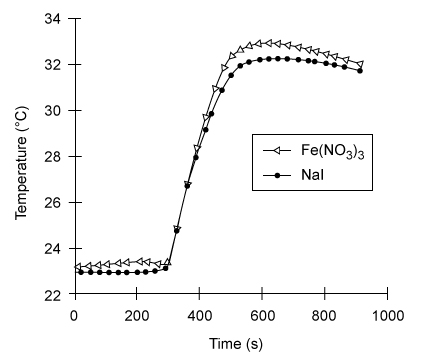
Passage Living organisms that require oxygen to respire can build up hydrogen peroxide (H<sub>2</sub>O<sub>2</sub>)  as a byproduct of respiration.  Because hydrogen peroxide can cause oxidative damage to cells, the amount of H<sub>2</sub>O<sub>2</sub> in cells must be closely regulated.  Although H<sub>2</sub>O<sub>2</sub> decomposes spontaneously, a catalyst is needed for the reaction to occur at a sufficiently rapid rate suitable for biological purposes.  In biological systems, an enzyme called a catalase accelerates the catalytic decomposition of H<sub>2</sub>O<sub>2</sub> into water and oxygen (Reaction 1) .    <strong>Reaction 1</strong>In a laboratory setting, several different inorganic compounds can also serve as catalysts for H<sub>2</sub>O<sub>2</sub> decomposition, allowing researchers to compare how different catalysts affect the efficiency of the reaction.  To compare Fe(NO<sub>3</sub>) <sub>3</sub> (a metal homogeneous catalyst)  and NaI (a halogen homogeneous catalyst) , researchers measured the amount of heat evolved after placing each catalyst in a fresh solution of 3% hydrogen peroxide.To perform the measurements, the researchers placed 50 mL of 3% H<sub>2</sub>O<sub>2</sub> in an insulated coffee cup to be used as a calorimeter, as shown in Figure 1.  Before adding any catalyst, the initial, baseline temperature of the H<sub>2</sub>O<sub>2</sub> solution was determined by recording the temperature every 30 seconds for 5 minutes.  Then 10 mL of 0.10 M Fe(NO<sub>3</sub>) <sub>3</sub>(aq)  catalyst was added to the H<sub>2</sub>O<sub>2</sub> solution.  The temperature was recorded every 30 seconds for another 15 minutes.  The experiment was then repeated using 10 mL of 0.50 M sodium iodide in 0.01 M NaOH as the catalyst.  The results for each reaction are shown in Figure 2.    <strong>Figure 1</strong>  Coffee cup calorimeter    <strong>Figure 2</strong>  Temperature vs. time measurements for reactions catalyzed by Fe(NO<sub>3</sub>) <sub>3</sub> and NaI Adapted from: C. Marzzacco,  The effect of a change in catalyst on the enthalpy of decomposition of hydrogen peroxide.  Chem13 News Magazine. ©2008 University of Waterloo. -Which of the following statements explains why the change in temperature of the H<sub>2</sub>O<sub>2</sub> decomposition reaction using Fe(NO<sub>3</sub>) <sub>3</sub> is approximately the same value as the change in temperature using NaI? A) Fe(NO<sub>3</sub>) <sub>3</sub> stabilizes the transition state more than NaI. B) Fe(NO<sub>3</sub>) <sub>3</sub> results in a faster reaction rate than NaI. C) Fe(NO<sub>3</sub>) <sub>3</sub> and NaI are both homogeneous catalysts. D) Fe(NO<sub>3</sub>) <sub>3</sub> and NaI do not affect the heat of the reaction. Reaction 1In a laboratory setting, several different inorganic compounds can also serve as catalysts for H2O2 decomposition, allowing researchers to compare how different catalysts affect the efficiency of the reaction.  To compare Fe(NO3) 3 (a metal homogeneous catalyst) and NaI (a halogen homogeneous catalyst) , researchers measured the amount of heat evolved after placing each catalyst in a fresh solution of 3% hydrogen peroxide.To perform the measurements, the researchers placed 50 mL of 3% H2O2 in an insulated coffee cup to be used as a calorimeter, as shown in Figure 1.  Before adding any catalyst, the initial, baseline temperature of the H2O2 solution was determined by recording the temperature every 30 seconds for 5 minutes.  Then 10 mL of 0.10 M Fe(NO3) 3(aq) catalyst was added to the H2O2 solution.  The temperature was recorded every 30 seconds for another 15 minutes.  The experiment was then repeated using 10 mL of 0.50 M sodium iodide in 0.01 M NaOH as the catalyst.  The results for each reaction are shown in Figure 2.
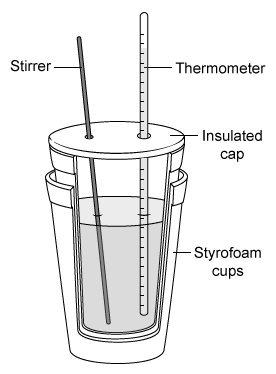
Passage Living organisms that require oxygen to respire can build up hydrogen peroxide (H<sub>2</sub>O<sub>2</sub>)  as a byproduct of respiration.  Because hydrogen peroxide can cause oxidative damage to cells, the amount of H<sub>2</sub>O<sub>2</sub> in cells must be closely regulated.  Although H<sub>2</sub>O<sub>2</sub> decomposes spontaneously, a catalyst is needed for the reaction to occur at a sufficiently rapid rate suitable for biological purposes.  In biological systems, an enzyme called a catalase accelerates the catalytic decomposition of H<sub>2</sub>O<sub>2</sub> into water and oxygen (Reaction 1) .    <strong>Reaction 1</strong>In a laboratory setting, several different inorganic compounds can also serve as catalysts for H<sub>2</sub>O<sub>2</sub> decomposition, allowing researchers to compare how different catalysts affect the efficiency of the reaction.  To compare Fe(NO<sub>3</sub>) <sub>3</sub> (a metal homogeneous catalyst)  and NaI (a halogen homogeneous catalyst) , researchers measured the amount of heat evolved after placing each catalyst in a fresh solution of 3% hydrogen peroxide.To perform the measurements, the researchers placed 50 mL of 3% H<sub>2</sub>O<sub>2</sub> in an insulated coffee cup to be used as a calorimeter, as shown in Figure 1.  Before adding any catalyst, the initial, baseline temperature of the H<sub>2</sub>O<sub>2</sub> solution was determined by recording the temperature every 30 seconds for 5 minutes.  Then 10 mL of 0.10 M Fe(NO<sub>3</sub>) <sub>3</sub>(aq)  catalyst was added to the H<sub>2</sub>O<sub>2</sub> solution.  The temperature was recorded every 30 seconds for another 15 minutes.  The experiment was then repeated using 10 mL of 0.50 M sodium iodide in 0.01 M NaOH as the catalyst.  The results for each reaction are shown in Figure 2.    <strong>Figure 1</strong>  Coffee cup calorimeter    <strong>Figure 2</strong>  Temperature vs. time measurements for reactions catalyzed by Fe(NO<sub>3</sub>) <sub>3</sub> and NaI Adapted from: C. Marzzacco,  The effect of a change in catalyst on the enthalpy of decomposition of hydrogen peroxide.  Chem13 News Magazine. ©2008 University of Waterloo. -Which of the following statements explains why the change in temperature of the H<sub>2</sub>O<sub>2</sub> decomposition reaction using Fe(NO<sub>3</sub>) <sub>3</sub> is approximately the same value as the change in temperature using NaI? A) Fe(NO<sub>3</sub>) <sub>3</sub> stabilizes the transition state more than NaI. B) Fe(NO<sub>3</sub>) <sub>3</sub> results in a faster reaction rate than NaI. C) Fe(NO<sub>3</sub>) <sub>3</sub> and NaI are both homogeneous catalysts. D) Fe(NO<sub>3</sub>) <sub>3</sub> and NaI do not affect the heat of the reaction. Figure 1  Coffee cup calorimeter
Passage Living organisms that require oxygen to respire can build up hydrogen peroxide (H<sub>2</sub>O<sub>2</sub>)  as a byproduct of respiration.  Because hydrogen peroxide can cause oxidative damage to cells, the amount of H<sub>2</sub>O<sub>2</sub> in cells must be closely regulated.  Although H<sub>2</sub>O<sub>2</sub> decomposes spontaneously, a catalyst is needed for the reaction to occur at a sufficiently rapid rate suitable for biological purposes.  In biological systems, an enzyme called a catalase accelerates the catalytic decomposition of H<sub>2</sub>O<sub>2</sub> into water and oxygen (Reaction 1) .    <strong>Reaction 1</strong>In a laboratory setting, several different inorganic compounds can also serve as catalysts for H<sub>2</sub>O<sub>2</sub> decomposition, allowing researchers to compare how different catalysts affect the efficiency of the reaction.  To compare Fe(NO<sub>3</sub>) <sub>3</sub> (a metal homogeneous catalyst)  and NaI (a halogen homogeneous catalyst) , researchers measured the amount of heat evolved after placing each catalyst in a fresh solution of 3% hydrogen peroxide.To perform the measurements, the researchers placed 50 mL of 3% H<sub>2</sub>O<sub>2</sub> in an insulated coffee cup to be used as a calorimeter, as shown in Figure 1.  Before adding any catalyst, the initial, baseline temperature of the H<sub>2</sub>O<sub>2</sub> solution was determined by recording the temperature every 30 seconds for 5 minutes.  Then 10 mL of 0.10 M Fe(NO<sub>3</sub>) <sub>3</sub>(aq)  catalyst was added to the H<sub>2</sub>O<sub>2</sub> solution.  The temperature was recorded every 30 seconds for another 15 minutes.  The experiment was then repeated using 10 mL of 0.50 M sodium iodide in 0.01 M NaOH as the catalyst.  The results for each reaction are shown in Figure 2.    <strong>Figure 1</strong>  Coffee cup calorimeter    <strong>Figure 2</strong>  Temperature vs. time measurements for reactions catalyzed by Fe(NO<sub>3</sub>) <sub>3</sub> and NaI Adapted from: C. Marzzacco,  The effect of a change in catalyst on the enthalpy of decomposition of hydrogen peroxide.  Chem13 News Magazine. ©2008 University of Waterloo. -Which of the following statements explains why the change in temperature of the H<sub>2</sub>O<sub>2</sub> decomposition reaction using Fe(NO<sub>3</sub>) <sub>3</sub> is approximately the same value as the change in temperature using NaI? A) Fe(NO<sub>3</sub>) <sub>3</sub> stabilizes the transition state more than NaI. B) Fe(NO<sub>3</sub>) <sub>3</sub> results in a faster reaction rate than NaI. C) Fe(NO<sub>3</sub>) <sub>3</sub> and NaI are both homogeneous catalysts. D) Fe(NO<sub>3</sub>) <sub>3</sub> and NaI do not affect the heat of the reaction. Figure 2  Temperature vs. time measurements for reactions catalyzed by Fe(NO3) 3 and NaI
Adapted from: C. Marzzacco, "The effect of a change in catalyst on the enthalpy of decomposition of hydrogen peroxide." Chem13 News Magazine. ©2008 University of Waterloo.
-Which of the following statements explains why the change in temperature of the H2O2 decomposition reaction using Fe(NO3) 3 is approximately the same value as the change in temperature using NaI?


A) Fe(NO3) 3 stabilizes the transition state more than NaI.
B) Fe(NO3) 3 results in a faster reaction rate than NaI.
C) Fe(NO3) 3 and NaI are both homogeneous catalysts.
D) Fe(NO3) 3 and NaI do not affect the heat of the reaction.

Correct Answer:

verifed

Verified

Unlock this answer now
Get Access to more Verified Answers free of charge

Related Questions

Unlock this Answer For Free Now!

View this answer and more for free by performing one of the following actions

qr-code

Scan the QR code to install the App and get 2 free unlocks

upload documents

Unlock quizzes for free by uploading documents