Solved

A 19-Year-Old Girl Is Being Tested for New-Onset Generalized Tonic-Clonic

Question 74

Multiple Choice

A 19-year-old girl is being tested for new-onset generalized tonic-clonic seizures. She has also had unpredictable jerks of her arms and legs, as well as occasional muscular weakness, for several years. The girl has other family relatives who have identical symptoms. A neurological examination indicates a broad-based gait and diminished feeling in the lower limbs. A skeletal muscle biopsy reveals ragged, red-colored muscular fibers. Further investigation revealed that the patient's symptoms are caused by a mutation that affects extranuclear DNA. Which of the following pedigrees best describes this patient's family history? (The arrow points to the patient.)


A) A 19-year-old girl is being tested for new-onset generalized tonic-clonic seizures. She has also had unpredictable jerks of her arms and legs, as well as occasional muscular weakness, for several years. The girl has other family relatives who have identical symptoms. A neurological examination indicates a broad-based gait and diminished feeling in the lower limbs. A skeletal muscle biopsy reveals ragged, red-colored muscular fibers. Further investigation revealed that the patient's symptoms are caused by a mutation that affects extranuclear DNA. Which of the following pedigrees best describes this patient's family history? (The arrow points to the patient.)  A)    B)    C)    D)    E)
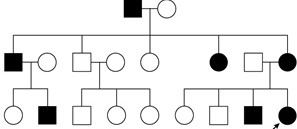
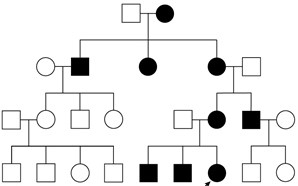
B) A 19-year-old girl is being tested for new-onset generalized tonic-clonic seizures. She has also had unpredictable jerks of her arms and legs, as well as occasional muscular weakness, for several years. The girl has other family relatives who have identical symptoms. A neurological examination indicates a broad-based gait and diminished feeling in the lower limbs. A skeletal muscle biopsy reveals ragged, red-colored muscular fibers. Further investigation revealed that the patient's symptoms are caused by a mutation that affects extranuclear DNA. Which of the following pedigrees best describes this patient's family history? (The arrow points to the patient.)  A)    B)    C)    D)    E)
C) A 19-year-old girl is being tested for new-onset generalized tonic-clonic seizures. She has also had unpredictable jerks of her arms and legs, as well as occasional muscular weakness, for several years. The girl has other family relatives who have identical symptoms. A neurological examination indicates a broad-based gait and diminished feeling in the lower limbs. A skeletal muscle biopsy reveals ragged, red-colored muscular fibers. Further investigation revealed that the patient's symptoms are caused by a mutation that affects extranuclear DNA. Which of the following pedigrees best describes this patient's family history? (The arrow points to the patient.)  A)    B)    C)    D)    E)
D) A 19-year-old girl is being tested for new-onset generalized tonic-clonic seizures. She has also had unpredictable jerks of her arms and legs, as well as occasional muscular weakness, for several years. The girl has other family relatives who have identical symptoms. A neurological examination indicates a broad-based gait and diminished feeling in the lower limbs. A skeletal muscle biopsy reveals ragged, red-colored muscular fibers. Further investigation revealed that the patient's symptoms are caused by a mutation that affects extranuclear DNA. Which of the following pedigrees best describes this patient's family history? (The arrow points to the patient.)  A)    B)    C)    D)    E)
E) A 19-year-old girl is being tested for new-onset generalized tonic-clonic seizures. She has also had unpredictable jerks of her arms and legs, as well as occasional muscular weakness, for several years. The girl has other family relatives who have identical symptoms. A neurological examination indicates a broad-based gait and diminished feeling in the lower limbs. A skeletal muscle biopsy reveals ragged, red-colored muscular fibers. Further investigation revealed that the patient's symptoms are caused by a mutation that affects extranuclear DNA. Which of the following pedigrees best describes this patient's family history? (The arrow points to the patient.)  A)    B)    C)    D)    E)

Correct Answer:

verifed

Verified

Unlock this answer now
Get Access to more Verified Answers free of charge

Related Questions

Unlock this Answer For Free Now!

View this answer and more for free by performing one of the following actions

qr-code

Scan the QR code to install the App and get 2 free unlocks

upload documents

Unlock quizzes for free by uploading documents