A 67-year-old woman comes to the physician because of edema and shortness of breath. She reports that the edema has been present for approximately 3-4 months and involves her lower extremities. The shortness of breath occurs with minimal exertion and occasionally at rest. She denies chest pain or pressure, cough, and fever.
She has history of breast cancer diagnosed 12 years ago that was treated with mastectomy, chemotherapy, and chest wall radiation therapy. Her medications include aspirin, fish oil, and simvastatin.
Her blood pressure is 115/70 mm Hg, pulse is 62/min, and BMI is 27 kg/m2. The patient is in no acute distress. Her lungs are clear bilaterally. There is a normal S1 and S2 with a 2/6 apical murmur that radiates to the axilla. She has 3+ pitting edema below the knees bilaterally.
Her electrocardiogram is shown below.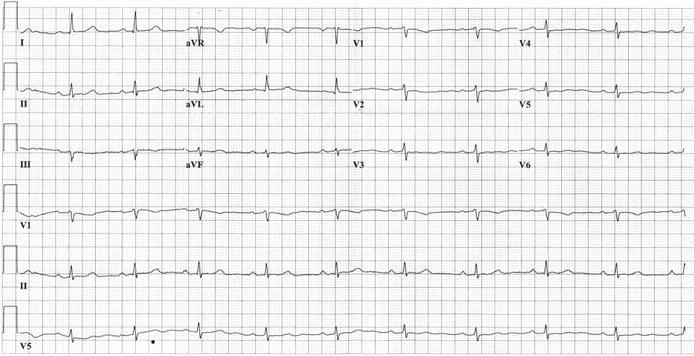
A transthoracic echocardiogram shows a normal left ventricular cavity size, a left ventricular ejection fraction of 70%, biatrial dilatation, severe left ventricular hypertrophy, and moderate mitral regurgitation.
Which of the following is the most likely additional finding in this patient?
A) Ascending aortic aneurysm
B) Carotid artery occlusion
C) Cavitary lung lesions
D) Hyperthyroidism
E) Significant proteinuria
Correct Answer:

Verified
Q31: A 46-year-old woman comes to the office
Q32: A 57-year-old man comes to the office
Q33: A 20-year-old man comes to the office
Q34: A 56-year-old man comes to the office
Q35: A 58-year-old woman comes to the physician
Q37: A 44-year-old man comes to the physician
Q38: A 77-year-old woman comes to the physician
Q39: A 63-year-old woman is admitted to the
Q40: A 32-year-old paramedic comes to the office
Q41: A 22-year-old man comes to the office
Unlock this Answer For Free Now!
View this answer and more for free by performing one of the following actions

Scan the QR code to install the App and get 2 free unlocks

Unlock quizzes for free by uploading documents