A 47-year-old woman is evaluated for a 6-month history of increasing fatigue, malaise, pruritus, and arthralgias. She has had no shortness of breath, chest pain, or fever. The patient was found to have abnormal liver chemistry tests on 2 occasions over the past 3 months. She takes no medications, drinks a glass of wine with dinner every day, and does not use tobacco or illicit drugs. The patient received a blood transfusion in childhood after surgery for a leg fracture.
Temperature is 36.5 C (97.7 F) , blood pressure is 110/60 mm Hg, pulse is 86/min, and respirations are 12/min. BMI is 25 kg/m2. There is no scleral icterus, lymphadenopathy, or skin rash. Cardiac examination reveals a 2/6 holosystolic murmur at the apex radiating to the axilla. The liver is palpable 4 cm below the right costal margin with no splenomegaly. There is no peripheral edema. Several of the small joints of the hands are mildly tender without erythema or swelling.
Laboratory results are as follows: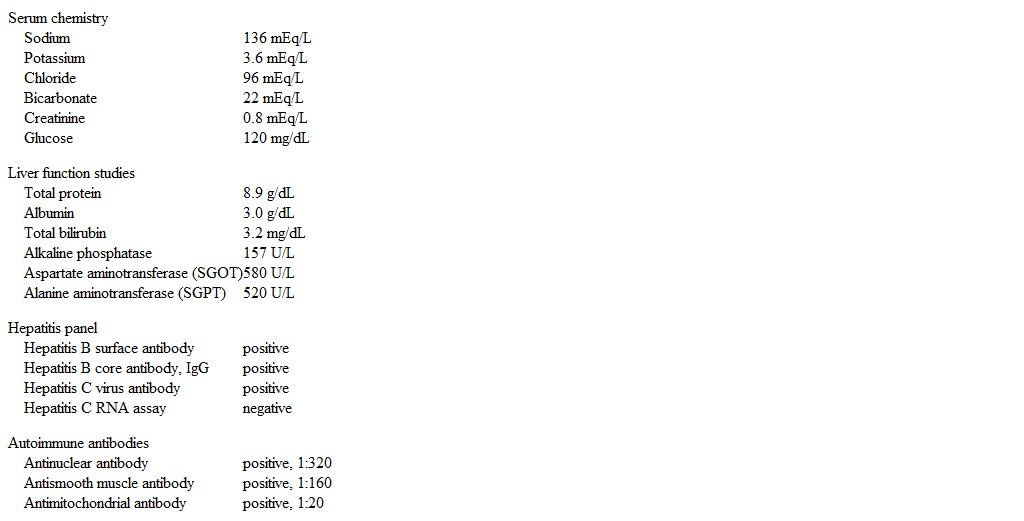 Which of the following is the most appropriate pharmacotherapy for this patient?
A) Calcineurin inhibitor
B) Direct-acting anti-hepatitis C therapy
C) Exogenous bile acid supplement
D) Glucocorticoid
E) Nucleotide analogue targeting hepatitis B virus
Correct Answer:

Verified
Q320: A 32-year-old man comes to the office
Q321: A 65-year-old man on chronic peritoneal dialysis
Q322: A 57-year-old man is evaluated for a
Q323: A 32-year-old man comes to the office
Q324: A 38-year-old woman comes to the office
Q326: A 44-year-old woman comes to the office
Q327: A 76-year-old woman comes to the physician
Q328: A 65-year-old man is evaluated for a
Q329: A 33-year-old man comes to the office
Q330: A 41-year-old woman comes to the office
Unlock this Answer For Free Now!
View this answer and more for free by performing one of the following actions

Scan the QR code to install the App and get 2 free unlocks

Unlock quizzes for free by uploading documents