A 57-year-old man is evaluated for a 6-month history of persistent diarrhea. The patient describes frequent soft to watery bowel movements that sometimes awaken him from sleep. He has had fecal incontinence on several occasions along with abdominal bloating and excessive flatulence but has had no fever, abdominal or rectal pain, tenesmus, melena, hematochezia, or weight loss. Medical history includes hypertension, peripheral vascular disease, and a 40-year history of diabetes mellitus treated with insulin. The patient has not traveled recently.
Temperature is 36.9 C (98.4 F) , blood pressure is 136/84 mm Hg supine and 122/77 mm Hg standing, and pulse is 72/min. The lungs are clear on auscultation and heart sounds are normal. The abdomen is nondistended, soft, and nontender with no palpable mass or hepatosplenomegaly. Bowel sounds are normal. Stool is negative for occult blood. Light touch and vibratory sensation are decreased on both feet, and bilateral ankle reflexes are absent.
Laboratory results are as follows: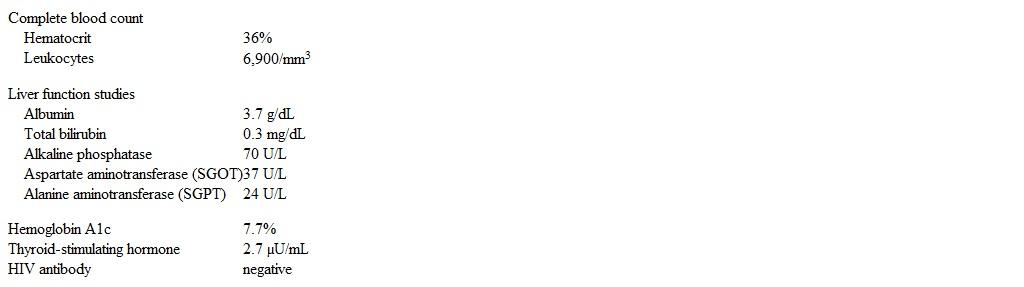 Stool is negative for ova and parasites, and stool culture grows no pathogenic bacteria. Colonoscopy reveals grossly normal mucosa; random biopsies are unrevealing. Small bowel follow-through barium studies and upper gastrointestinal endoscopy with random biopsies are normal.
Which of the following is most likely contributing to this patient's condition?
A) Bacterial overgrowth
B) Celiac disease
C) Diarrhea-predominant irritable bowel syndrome
D) Microscopic colitis
E) Pancreatic insufficiency
Correct Answer:

Verified
Q317: An 80-year-old hospitalized woman is evaluated for
Q318: A 42-year-old man comes to the office
Q319: A 61-year-old postmenopausal woman comes to the
Q320: A 32-year-old man comes to the office
Q321: A 65-year-old man on chronic peritoneal dialysis
Q323: A 32-year-old man comes to the office
Q324: A 38-year-old woman comes to the office
Q325: A 47-year-old woman is evaluated for a
Q326: A 44-year-old woman comes to the office
Q327: A 76-year-old woman comes to the physician
Unlock this Answer For Free Now!
View this answer and more for free by performing one of the following actions

Scan the QR code to install the App and get 2 free unlocks

Unlock quizzes for free by uploading documents