A 2-year-old boy is brought to the emergency department by his grandmother due to abdominal pain and lethargy. The grandmother reports that he was playing calmly last night when he suddenly began screaming and holding his abdomen. The pain resolved after several minutes, but the patient has had 5 additional episodes of sudden-onset, severe pain since then. Today, the grandmother notes that he has no interest in eating or drinking and has been "sleeping all day" but intermittently awakens in pain. The patient has also had several episodes of nonbloody, nonbilious emesis and "fewer wet diapers than usual." He has had no fever, diarrhea, or recent infections. He is an otherwise healthy child with no prior hospitalizations or chronic medical conditions. The patient takes no medications, and his immunizations are up to date. Temperature is 37 C (98.6 F) , blood pressure is 90/56 mm Hg, pulse is 160/min, and respirations are 24/min. During the examination, the boy is sleeping and arouses briefly. The abdomen has hypoactive bowel sounds and diffuse mild tenderness to palpation. He is circumcised, with both testes descended and with intact cremasteric reflexes. Immediately after the examination, the child passes blood in his diaper, as shown in the image below. 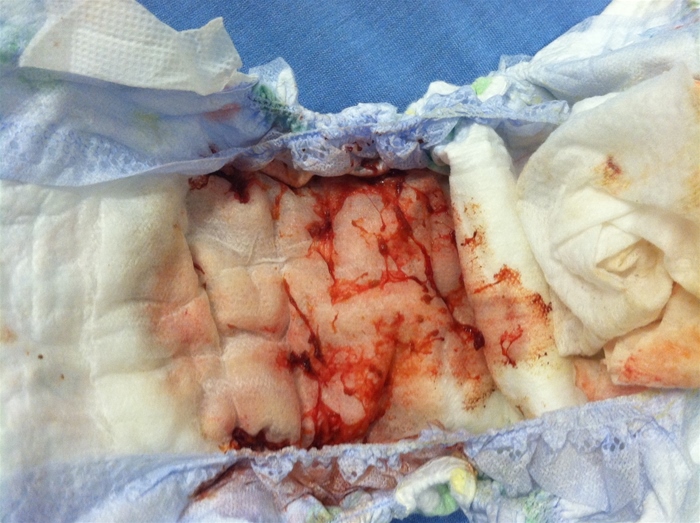 The medical team has determined the appropriate procedure. The patient lives with his parents and his grandmother about an hour away from the hospital. His grandmother drove him to the emergency department but is not his legal guardian. She states, "His mom should be on the way; she probably just left the house." However, despite multiple attempts, the medical team is unable to reach either of the patient's parents by telephone. Which of the following is the most appropriate next step in management of this patient?
A) Delay the procedure until informed consent is obtained from both the mother and the father
B) Delay the procedure until informed consent is obtained from either the mother or the father
C) Proceed with the procedure after the grandmother provides informed consent
D) Proceed with the procedure after the patient provides informed consent
E) Proceed with the procedure without informed consent
Correct Answer:

Verified
Q355: A 7-year-old girl is brought to the
Q356: A 45-year-old man comes to the office
Q357: A 3-year-old boy is brought to the
Q358: A 64-year-old woman comes to the office
Q359: A 45-year-old man comes to the clinic
Q361: A 53-year-old man comes to the office
Q362: A 60-year-old man comes to the physician
Q363: A 54-year-old woman comes to the emergency
Q364: A 3-year-old boy is brought to the
Q365: A 6-week-old boy is brought to the
Unlock this Answer For Free Now!
View this answer and more for free by performing one of the following actions

Scan the QR code to install the App and get 2 free unlocks

Unlock quizzes for free by uploading documents