Solved

A 45-Year-Old Man Is Brought to the Emergency Department by His

Question 376

Multiple Choice

A 45-year-old man is brought to the emergency department by his wife due to progressive lethargy, confusion, and abdominal pain.  He has had no hematemesis, melena, or hematochezia.  The patient has a history of alcoholic cirrhosis.  He had a variceal hemorrhage 2 months ago and has been treated previously for hepatic encephalopathy.  The patient takes nadolol, furosemide, spironolactone, and lactulose at home.  There have been no changes in his dietary intake, and he has not used any over-the-counter medicines or herbal supplements.  He still occasionally drinks alcohol but does not use tobacco or illicit drugs.  Temperature is 38 C (100.4 F) , blood pressure is 104/60 mm Hg, and pulse is 96/min.  The patient is cachectic and somnolent, and he wakes up with painful stimuli.  He has a flapping tremor of both hands, and the speech is slurred and incomprehensible.  Mucous membranes are dry, and he has scleral icterus.  Several spider angiomata are present on the upper torso.  The lungs are clear to auscultation, and heart sounds are normal with no murmur.  The abdomen is distended and tense with large abdominal wall collaterals.  There is a fluid wave and diffuse tenderness but no rebound tenderness.  Bowel sounds are decreased.  Stool occult blood is negative.  Laboratory results are as follows:
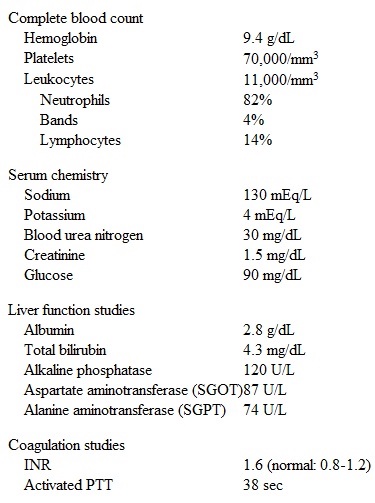
A 45-year-old man is brought to the emergency department by his wife due to progressive lethargy, confusion, and abdominal pain.  He has had no hematemesis, melena, or hematochezia.  The patient has a history of alcoholic cirrhosis.  He had a variceal hemorrhage 2 months ago and has been treated previously for hepatic encephalopathy.  The patient takes nadolol, furosemide, spironolactone, and lactulose at home.  There have been no changes in his dietary intake, and he has not used any over-the-counter medicines or herbal supplements.  He still occasionally drinks alcohol but does not use tobacco or illicit drugs.  Temperature is 38 C (100.4 F) , blood pressure is 104/60 mm Hg, and pulse is 96/min.  The patient is cachectic and somnolent, and he wakes up with painful stimuli.  He has a flapping tremor of both hands, and the speech is slurred and incomprehensible.  Mucous membranes are dry, and he has scleral icterus.  Several spider angiomata are present on the upper torso.  The lungs are clear to auscultation, and heart sounds are normal with no murmur.  The abdomen is distended and tense with large abdominal wall collaterals.  There is a fluid wave and diffuse tenderness but no rebound tenderness.  Bowel sounds are decreased.  Stool occult blood is negative.  Laboratory results are as follows:   A diagnostic paracentesis is performed, and the ascitic fluid results are as follows:   The patient is hospitalized, and appropriate therapy is started.  The patient's wife inquires about his overall prognosis.  Which of the following is the most useful indicator for 90-day mortality in this patient? A) Platelet count B) Serum albumin C) Serum aminotransferase D) Serum ammonia E) Serum creatinine
A diagnostic paracentesis is performed, and the ascitic fluid results are as follows: A 45-year-old man is brought to the emergency department by his wife due to progressive lethargy, confusion, and abdominal pain.  He has had no hematemesis, melena, or hematochezia.  The patient has a history of alcoholic cirrhosis.  He had a variceal hemorrhage 2 months ago and has been treated previously for hepatic encephalopathy.  The patient takes nadolol, furosemide, spironolactone, and lactulose at home.  There have been no changes in his dietary intake, and he has not used any over-the-counter medicines or herbal supplements.  He still occasionally drinks alcohol but does not use tobacco or illicit drugs.  Temperature is 38 C (100.4 F) , blood pressure is 104/60 mm Hg, and pulse is 96/min.  The patient is cachectic and somnolent, and he wakes up with painful stimuli.  He has a flapping tremor of both hands, and the speech is slurred and incomprehensible.  Mucous membranes are dry, and he has scleral icterus.  Several spider angiomata are present on the upper torso.  The lungs are clear to auscultation, and heart sounds are normal with no murmur.  The abdomen is distended and tense with large abdominal wall collaterals.  There is a fluid wave and diffuse tenderness but no rebound tenderness.  Bowel sounds are decreased.  Stool occult blood is negative.  Laboratory results are as follows:   A diagnostic paracentesis is performed, and the ascitic fluid results are as follows:   The patient is hospitalized, and appropriate therapy is started.  The patient's wife inquires about his overall prognosis.  Which of the following is the most useful indicator for 90-day mortality in this patient? A) Platelet count B) Serum albumin C) Serum aminotransferase D) Serum ammonia E) Serum creatinine The patient is hospitalized, and appropriate therapy is started.  The patient's wife inquires about his overall prognosis.  Which of the following is the most useful indicator for 90-day mortality in this patient?


A) Platelet count
B) Serum albumin
C) Serum aminotransferase
D) Serum ammonia
E) Serum creatinine

Correct Answer:

verifed

Verified

Unlock this answer now
Get Access to more Verified Answers free of charge

Related Questions

Unlock this Answer For Free Now!

View this answer and more for free by performing one of the following actions

qr-code

Scan the QR code to install the App and get 2 free unlocks

upload documents

Unlock quizzes for free by uploading documents