A 68-year-old man comes to the emergency department with persistent abdominal pain. Three days ago, the patient received a CT scan of the abdomen and pelvis for abdominal pain and was diagnosed with acute diverticulitis. Since then, he has taken ciprofloxacin and metronidazole, but his symptoms have not improved. The patient has continued nausea, decreased appetite, malaise, and constant left lower quadrant abdominal pain. He has a history of hypertension, hyperlipidemia, and gout. He is a former smoker and occasionally drinks alcohol. Several benign polyps were removed during a colonoscopy 8 years ago. Temperature is 38 C (100.4 F) , blood pressure is 140/80 mm Hg, pulse is 102/min, and respirations are 18/min. Abdomen is soft and nondistended, with significant left lower quadrant tenderness but no rebound guarding. Bowel sounds are decreased. Rectal examination reveals left-sided tenderness and negative occult blood stool. Laboratory results are as follows: 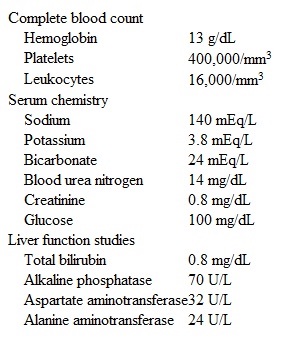 Which of the following is the best next step in management of this patient?
A) Arrange for laparotomy and partial colectomy
B) Obtain repeat CT scan of the abdomen and pelvis
C) Perform colonoscopy to rule out other pathology
D) Provide reassurance, continue oral antibiotics, and discharge with close follow-up
E) Start intravenous antibiotics and a clear liquid diet and observe in the hospital for 24-48 hours
Correct Answer:

Verified
Q373: A 60-year-old man comes to the office
Q374: A 25-year-old man comes to the office
Q375: A 63-year-old man comes to the emergency
Q376: A 45-year-old man is brought to the
Q377: A 43-year-old Chinese-American man comes to the
Q379: A 61-year-old man comes to the office
Q380: A 40-year-old man comes to the office
Q381: A 62-year-old man comes to the office
Q382: A 46-year-old man is brought to the
Q383: A 32-year-old Hispanic man comes to the
Unlock this Answer For Free Now!
View this answer and more for free by performing one of the following actions

Scan the QR code to install the App and get 2 free unlocks

Unlock quizzes for free by uploading documents