A 70-year-old woman comes to the office due to back pain, fatigue, and inability to carry out her daily work. The pain began 6 months ago and has slowly intensified. The patient had a hip fracture 3 months ago but has no other medical conditions. She is a lifetime nonsmoker and drinks alcohol on social occasions. She currently takes no medications. The patient has no extremity weakness or paresthesia. She has mild constipation; urination is normal. Initial laboratory results are as follows: 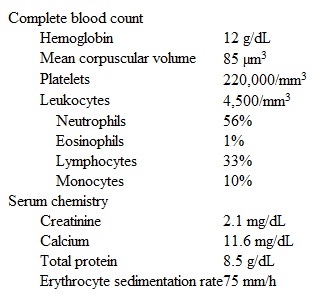 Dipstick urinalysis is normal. The patient is informed about the prognosis, potential risks, and benefits of therapy. She declines treatment. The physician documents their discussions and arranges for follow-up visits. One month later, the patient is brought to the emergency department by family members due to acute-onset blurry vision, headache, confusion, and epistaxis. A detailed history from the family members fails to identify any precipitating factor. On examination, the patient is lethargic but arousable. Scant gingival bleeding is noted. The lungs are clear to auscultation; there is no peripheral edema. Serum creatinine is 2.4 mg/dL. Which of the following is the most likely cause of this patient's acute change in status?
A) Acute kidney injury
B) Acute liver failure
C) Disseminated intravascular coagulation
D) Hypercalcemia
E) Hyperviscosity syndrome
Correct Answer:

Verified
Q463: A 67-year-old woman comes to the emergency
Q464: A 70-year-old woman comes to the office
Q465: A 52-year-old Caucasian woman comes to the
Q466: A 4-year-old boy is brought to the
Q467: A 64-year-old man admitted to a rehabilitation
Q469: A 25-year-old Caucasian man comes to see
Q470: A 54-year-old man with new-onset type 2
Q471: A 48-hour-old boy is evaluated in the
Q472: A previously healthy 30-year-old woman is admitted
Q473: A 70-year-old woman comes to the office
Unlock this Answer For Free Now!
View this answer and more for free by performing one of the following actions

Scan the QR code to install the App and get 2 free unlocks

Unlock quizzes for free by uploading documents