A 25-year-old man is brought to the emergency department due to high-grade fever, chills, myalgias, and skin rash, which started on the day of admission. He also had nausea and 3 episodes of profuse watery diarrhea and is now feeling lightheaded. Two days ago, he underwent corrective surgery for a deviated nasal septum but otherwise has no other past medical history. The patient has not traveled recently and has not been around sick contacts. He does not use illicit drugs. His temperature is 39.4 C (103 F) , blood pressure is 85/50 mm Hg, and pulse is 116/min. Oxygen saturation is 98% on room air. He is lethargic but has no focal weakness or nuchal rigidity. Examination shows clear lung fields and tachycardia with normal first and second heart sounds. The abdomen is soft and nontender. There is nasal packing in both nostrils. Skin examination shows a diffuse, red, macular rash that also involves the palms and soles. 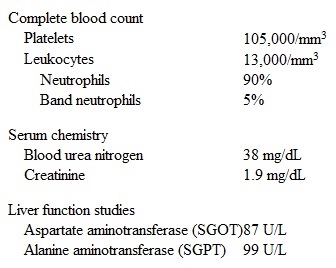 Blood cultures are sent. Which of the following is the most important next step in the treatment of this patient?
A) Dobutamine infusion
B) Epinephrine injection and antihistamines
C) Intravenous fluid infusion and antibiotic therapy
D) Intravenous fluid infusion and high-dose corticosteroids
E) Polyclonal human immunoglobulin
Correct Answer:

Verified
Q611: A 25-year-old man is brought to the
Q612: A 4-year-old girl is brought to the
Q613: A 25-year-old woman comes to the office
Q614: A 28-year-old primigravid woman comes to the
Q615: A 48-year-old man comes to the emergency
Q617: A 26-year-old man comes to the office
Q618: A 52-year-old man comes to the office
Q619: A 24-year-old woman, gravida 1 para 0,
Q620: A 25-year-old man comes to the employee
Q621: A 26-year-old woman comes to the office
Unlock this Answer For Free Now!
View this answer and more for free by performing one of the following actions

Scan the QR code to install the App and get 2 free unlocks

Unlock quizzes for free by uploading documents