Passage
Malaria is caused by the parasite Plasmodium falciparum and is transmitted through a female mosquito bite. Although there are antimalarial treatments available, P. falciparum has become resistant to many of these drugs. P. falciparum cells contain a respiratory organelle called the apicoplast that is necessary for the parasite's survival but is not found in humans. Therefore, a new drug that targets this organelle could be useful in the treatment of malaria.A portion of the apicoplast protein ferredoxin (PfFd) is shown in Figure 1, with certain amino acid residues labeled. In the apicoplast, ferredoxin NADP+ reductase (PfFNR) interacts electrostatically with PfFd and catalyzes an electron transfer reaction. A compound that selectively inhibits this interaction could be a beneficial antimalarial agent.
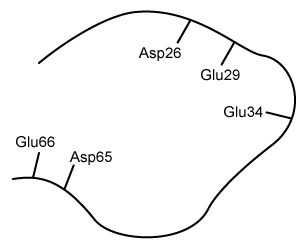 Figure 1 Structure of a portion of PfFdChalcone (Compound 3) is a compound that interacts with PfFd and exhibits antimalarial properties. A series of chalcone derivatives (Compounds 4-8) were synthesized via the aldol condensation shown in Scheme 1, where nucleophilic addition of Compound 1 to Compound 2 is followed by elimination to yield α,β-unsaturated carbonyl molecules, Compounds 3-8.
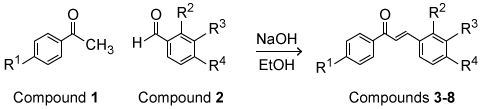 Scheme 1An inhibition assay was performed to compare chalcone (Compound 3) and its derivatives by determining the extent to which these compounds inhibited electron transfer between PfFNR and PfFd (Table 1) .Table 1 Inhibition of electron transfer assay results
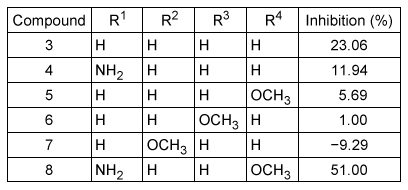 Adapted from H. Suwito et al. "Design and synthesis of chalcone derivatives as inhibitors of the ferredoxin - ferredoxin-NADP+ reductase interaction of Plasmodium falciparum: pursuing new antimalarial agents." Molecules. ©2014 MDPI.
-If Compound 4 is heated and treated with a base, which of the following functional groups would result from this reaction?
A) A ketone and an aldehyde
B) A ketone and an alcohol
C) Two aldehydes
D) Two ketones
Correct Answer:

Verified
Q141: A linear five-carbon ketone has a boiling
Q142: Passage
The protozoan Euglena gracilis expresses glycosyltransferases (enzymes
Q143: Passage
Malaria is caused by the parasite Plasmodium
Q144: Passage
The N-terminus of an amino acid must
Q145: Passage
The N-terminus of an amino acid must
Q147: Passage
The N-terminus of an amino acid must
Q148: A carboxylic acid is reacted with NaOH
Q149: Passage
Malaria is caused by the parasite Plasmodium
Q150: Passage
The protozoan Euglena gracilis expresses glycosyltransferases (enzymes
Q151: Thin-layer chromatography was used to determine the
Unlock this Answer For Free Now!
View this answer and more for free by performing one of the following actions

Scan the QR code to install the App and get 2 free unlocks

Unlock quizzes for free by uploading documents