A 34-year-old woman, gravida 5 para 4, at 39 weeks gestation is admitted to labor and delivery for contractions and spontaneous rupture of membranes. Her pregnancy has been uncomplicated, and her prior pregnancies ended in term vaginal deliveries. Prepregnancy BMI was 33 kg/m2 and she gained 18 kg (40 lb) this pregnancy. Two hours after admission, the patient receives neuraxial anesthesia and no longer feels contraction pain. After placement of neuraxial anesthesia, she has recurrent variable decelerations so an intrauterine catheter is placed. The variable decelerations resolve with amnioinfusion, and her labor continues. The patient's cervical examinations are shown on the labor curve below: 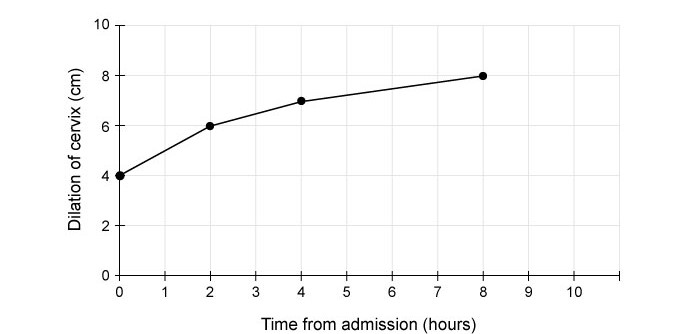 The fetal head is in the occiput posterior position. Fetal heart rate monitoring is category 1. An intrauterine pressure catheter shows 200 Montevideo units over 10 minutes for the past 4 hours. Which of the following is the most likely cause of this patient's labor curve?
A) Cephalopelvic disproportion
B) Contraction strength
C) Fetal gestational age
D) Maternal parity
E) Neuraxial anesthesia
Correct Answer:

Verified
Q333: A 28-year-old primigravida was admitted to the
Q334: A 19-year-old woman comes to the office
Q335: A 30-year-old woman, gravida 3 para 2,
Q336: A 37-year-old woman, gravida 3 para 2,
Q337: A 29-year-old woman, gravida 2 para 1,
Q339: A 32-year-old woman, gravida 2 para 1,
Q340: A 39-year-old woman, gravida 2 para 1,
Q341: A 29-year-old woman, gravida 1 para 0,
Q342: A 29-year-old woman, gravida 2 para 0,
Q343: A 24-year-old woman, gravida 1 para 0,
Unlock this Answer For Free Now!
View this answer and more for free by performing one of the following actions

Scan the QR code to install the App and get 2 free unlocks

Unlock quizzes for free by uploading documents