Passage Electrospray Ionization Mass Spectrometry (ESI-MS) Employs a Soft Ionization Technique
Passage
Electrospray ionization mass spectrometry (ESI-MS) employs a soft ionization technique that, unlike traditional ionization via electron bombardment, results in little to no fragmentation of target molecules. During electron bombardment, electrons collide with the analyte and cause the molecule to lose an electron whereas during ESI-MS, ions are produced by passing the analyte solution through an electrospray needle that has a potential difference applied with respect to a counterelectrode. This leads to the formation of charged droplets, which are repelled from the needle toward the counterelectrode and mass spectrometer, as shown in Figure 1.
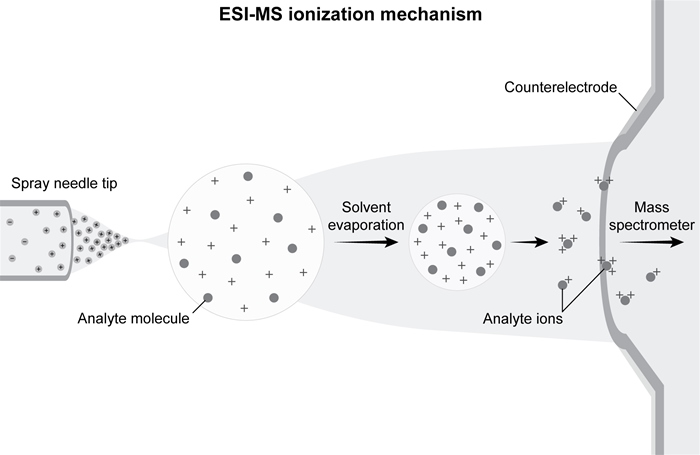 Figure 1 ESI-MS ionization mechanismDuring the droplet's flight, the solvent is evaporated off analyte molecules. Ionization occurs through the protonation of basic sites on target molecules. Reaction 1 shows the number of protons n added to molecule M.M → (M + nH) n+Reaction 1Researchers used ESI-MS to quantify the formation of four pyridyloxobutyl-DNA (POB-DNA) adducts, shown in Figure 2. POB-DNA adduct formation involves highly mutagenic pyridyloxobutylating agents, which are formed from cytochrome P450-mediated hydroxylation of 4-(methylnitrosamino) -1-(3-pyridyl) -1-butanone (NNK) , an abundant N-nitrosamine carcinogen found in cigarette smoke. Adducts were produced in vitro by treating samples of calf thymus DNA with NNK. The DNA adducts were then separated by reversed-phase high-performance liquid chromatography (RP-HPLC) and analyzed via ESI-MS.
 Figure 2 Molecular structure of POB-DNA adducts
Adapted from Lao Y, Villalta PW, Sturla SJ, Wang M, Hecht SS. Quantitation of pyridyloxobutyl DNA adducts of tobacco-specific nitrosamines in rat tissue DNA by high-performance liquid chromatography-electrospray ionization-tandem mass spectrometry. Chem Res Toxicol. 2006.
-Which of the following changes could be made to this experiment to increase the signal intensity of peaks that correspond to smaller mass-to-charge (m/z) values relative to larger m/z values?
A) Increase the pH of the sample solvent
B) Decrease the pH of the sample solvent
C) Decrease the concentration of the sample
D) Increase the concentration of the sample
Correct Answer:

Verified
Q76: Which of the following amino acids would
Q77: Passage
Fluorescent amino acids are useful for labeling
Q78: The (R)-enantiomer of the antiasthma drug albuterol
Q79: A solution of Compound 1, shown below,
Q80: Passage
Fluorescent amino acids are useful for labeling
Q82: Passage
Electrospray ionization mass spectrometry (ESI-MS) employs a
Q83: Passage
A group of students studied the reactivity
Q84: Passage
A group of students studied the reactivity
Q85: Which of the following statements accurately describes
Q86: Passage
A group of students studied the reactivity
Unlock this Answer For Free Now!
View this answer and more for free by performing one of the following actions

Scan the QR code to install the App and get 2 free unlocks

Unlock quizzes for free by uploading documents