A 63-year-old man with chronic obstructive pulmonary disease is brought to the emergency department due to fever, chills, and shortness of breath for 5 days. His medications include aspirin, inhaled albuterol, and inhaled ipratropium. The patient has smoked a pack of cigarettes daily for 43 years and drinks 3-4 cans of beer daily. His trachea is intubated in the emergency department due to respiratory distress, and intravenous antibiotics and glucocorticoids are initiated.
In the intensive care unit, temperature is 38.3 C (100.9 F) , blood pressure is 130/80 mm Hg, pulse is 132/min, and respirations are 22/min. Pulse oximetry shows 94% on assist-control mode with a tidal volume of 550 mL, respiratory rate of 22/min, fraction of inspired oxygen of 60%, and positive end-expiratory pressure of 5 mm H2O. Examination reveals diffuse crackles over the left lung, normal S1 and S2, and clubbing.
Laboratory studies are as follows: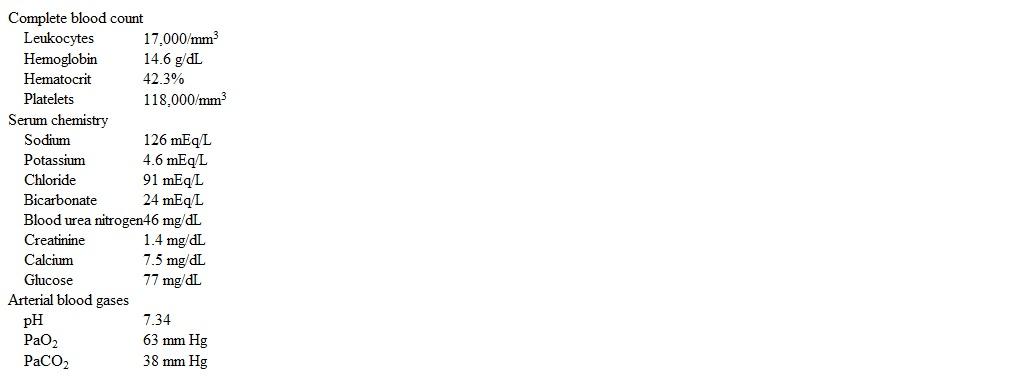 Chest-x ray shows a left-sided infiltrate and hyperinflated lungs. The ventilator waveforms show air trapping.
Which of the following is the most appropriate next step in management of this patient?
A) Decrease expiratory time
B) Decrease inspiratory flow
C) Decrease respiratory rate
D) Increase fraction of inspired oxygen
E) Increase tidal volume
Correct Answer:

Verified
Q93: A 79-year-old man on mechanical ventilation is
Q94: A 55-year-old woman is hospitalized for shortness
Q95: A 43-year-old man with alcoholic pancreatitis is
Q96: A 36-year-old woman comes to the emergency
Q97: A 65-year-old woman with a history of
Q99: A 65-year-old woman with a history of
Q100: A 60-year-old woman is brought to the
Q101: A 64-year-old woman was found poorly responsive
Q102: A 48-year-old man comes to the emergency
Q103: A 48-year-old man is admitted to the
Unlock this Answer For Free Now!
View this answer and more for free by performing one of the following actions

Scan the QR code to install the App and get 2 free unlocks

Unlock quizzes for free by uploading documents